 June 10, 2008 Posted by Roger Overton
 closeAuthor: Roger Overton
Name: Roger Overton
closeAuthor: Roger Overton
Name: Roger Overton
Email: rogeroverton@hotmail.com
Site: http://ateamblog.com
About: Roger Overton is currently pursuing a Masters degree at Talbot School of Theology. He has addressed various churches, schools and youth camps throughout the United States. Roger was co-editor of The New Media Frontier (Crossway, 2008) and God and Governing (Wipf & Stock, 2009).
Roger can be emailed at rogeroverton@hotmail.com.See Authors Posts (570)
Go here for the introduction to this interview.
There's been a lot of chatter on the internet discussing your book, Planet
Narnia. Almost every conversant seems to fall into one of two camps: those
who have not read the book and think your idea is preposterous, and those who
have read it and at least agree with most of your thesis. As you've traveled
throughout the and U.K for most of this year, how has reception been among people you've met?
I'm delighted to say that the reception has been
overwhelmingly positive. Of course, there will be a rew nay-sayers;
that's to be expected with such a large claim as the one I'm making. And
usually the scepticism comes from people who haven't read the book, or who
haven't read it in full. But the vast majority of people, including
established Lewis scholars such as Alan Jacobs, Wayne Martindale, Walter
Hooper, Andrew Cuneo, Christopher Mitchell, Sarah Arthur, and many others
besides, believe that there is a genuine literary secret here that has finally
been unearthed. To see what they are saying about the book, please take a
look at: http://www.planetnarnia.com/planet-narnia/reviews
|
|
In Planet Narnia, you discuss how following the Copernican revolution
astrology and astronomy became separated. It appears that a naturalistic
worldview dismissed the “non-scientific” understanding of the
planets. You also note that “even where astrology is explicit in Lewis's
work, it has received surprisingly little attention” (245) from Lewis
scholars. Do you think this quick dismissal or avoidance of astrology among
Christians today is related to the naturalism or materialism promoted by
science?
I think that's one of the reasons, yes. Christians who
are too anxious to achieve scientific 'respectability' have bought into the
naturalistic paradigm, – the idea that nature is just so much raw material to
be chopped up and studied without reference to its connection with us, its
fellow creatures, or its Creator. Three other reasons spring to mind.
1. An unbalanced notion of human 'dominion' over
nature, – where dominion is mistakenly glossed as 'domination'
2. An excessive focus upon the distinction between
'nature' and 'grace'. Lewis criticised this in Karl Barth. Lewis
preferred Richard Hooker's line of thinking, in which 'nature hath need of
grace' but, also, 'grace hath use of nature'. In an incarnational
religion, such as Christianity, one can't draw a hard and fast line between
matter and spirit. Christ has honoured human nature by taking it upon
himself, and by being resurrected in bodily form.
3. An unbalanced reading of scripture, focusing only
upon the condemnations of astrology, and not recalling that there is a much
more positive view of star-lore in the Bible as well: e.g. Judges 5:20, Job
38:31, Psalm 19:1-3; Matthew 2:1-10; 24:29, etc.
You say of C.S. Lewis that, “He was not prepared to write off a view
of the cosmos, as his schoolmasters had written off paganism, simply because it
had been shown to be factually inadequate; ideas could be entertained for their
beauty, not just their truth.” (29) This seems to suggest that something
can be beautiful without being connected to truth. How can something false be
beautiful?
Let us distinguish two kinds of falseness. There is a
bad falseness, the falseness of a lie, but there is also a good falseness, the
'falseness' of a story. Both can be beautiful.
The former kind of falseness is dangerous because of its
beauty, its power to attract. It's because temptations to sin can be
attractive that they are hard to resist. The devil can appear 'as an
angel of light'. Lewis pointed out how the idea of 'the beautiful but
evil fay' has all but disappeared from the modern imagination, which is one of
the reasons why the beauty of Jadis in 'The Magician's Nephew' is so
emphasized. She is evil, merciless, false, but she is beautiful.
But there is a second kind of falseness, which is better
called not falseness, but fiction or metaphorical thinking. When Jesus
told parables he was not relating historical events; rather, he was using his
imagination (his power of thinking metaphorically) in a good way. We
don't need to believe that he had a particular fatted calf in mind when he told
the story of the prodigal son. Parables, though 'false' as histories of
particular events, are still true and good and – yes, beautiful – as stories.
It's in this sense that Lewis approached scientific models
of the cosmos. Models of the cosmos are products of the human
imagination. (Imagination, Lewis thought, was essential to rational
thought.) They come and they go. Once upon a time people believed
in the Ptolemaic story of cosmological arrangements. Then they believed
in the Newtonian story. Then in the Einsteinian. None of these
models is the sum total of truth about the universe. Each gets in a
certain number of facts and leaves out others. In that sense, none is
fully true, but each is useful (some much more useful than others), and all
possess degrees of beauty. Lewis thought the Ptolemaic model especially
beautiful because of its orderliness, its comprehensiveness, its perfectly
graded hierarchy in which great and small are equally at home. For more
on why he thought this, read his book, 'The Discarded Image'.
Lewis said that, “the characters of the planets, as conceived by
medieval astrology, seem to me to have a permanent value as spiritual
symbols—to provide a Phanomenologie de Geistes which is specially worth
while in our own generation.” Is that medieval phenomenology still
relevant for today's postmodern generations?
It's important to quote the next sentence. Having said
that the planets are especially worth while in his own generation, Lewis goes
on to say: 'Of Saturn we know more than enough, but who does not need to be
reminded of Jove?' He says this because he thought his own generation had
been 'born under Saturn' (so to speak). Saturn was the planet of calamity
and death and disaster. Lewis thought that his own generation had been
born under Saturn because his own generation was that generation which was
doomed to grow up (and in many cases, not grow up) during the First World War.
Lewis had been a teenage officer in that conflict and was severely
wounded in the Battle of Arras in 1918. He described much of the poetry
of the 1920s and 1930s as 'Saturnocentric', – fixated upon Saturn and
associated pessimism, cynicism, and despair. That was a natural and
understandable response to the tragedy which was the Great War, but Lewis
thought that the Saturnine shadow cast over his own generation was a historical
accident and not an eternal truth about the universe. He thought that
Jupiter (Jove) was a much better representation of the heart of spiritual
reality, because Jovial qualities (kingliness, magnanimity, sacrifice,
festivity) were a good way of symbolising the Christian God.
In today's postmodern generation, we have not the same cause
for being Saturnocentric, though there is still plenty of cynicism and despair
around. Perhaps our current generation is more likely to be fixated with
Venus (sexuality) or with Luna (doubt), than Saturn.
Whichever planet currently 'dominates', Jupiter remains a
valuable summary of spiritual qualities, – qualities which are eternally
relevant, Lewis would argue, because they convey important aspects of the
divine nature.
In Spenser's Images of Life, Lewis coined the term
“donegality.” You've adopted this term to help you describe the
planetary themes you found in the Chronicles of Narnia. For those not
familiar with the word, what does it mean, and how is it helpful for this
study?
Lewis thought that many places, like many books, had an
indefinable quality, – hard to put into words, but unmistakable. London has its peculiar 'Londonness' and Donegal (in Ireland) has
its 'Donegality'. In 'Planet Narnia' I take this word, 'donegality', and
apply it to Lewis's technique of conveying atmosphere in the seven Narnia
Chronicles. I believe that what Lewis was attempting the Chronicles was a
new thing in imaginative literature, and that 'donegality' is a helpful term
because it encapsulates this new thing. By donegality I mean to denote
the spiritual essence or quiddity of the Narnia Chronicles as intended by Lewis
and inhabited unconsciously by the reader. The donegality of a story is its
peculiar atmosphere or quality; its pervasive and purposed integral tone or
flavour; its tacit spirit, a spirit that the author consciously sought to
conjure, but which was designed to remain implicit in the matter of the text,
despite being also concentrated and consummated in a Christologically
representative character, the more influentially to inform the work and so
affect the reader.
 Posted in Interviews, Main Page, Roger's Posts, Theology
  No Comments »
June 9, 2008 Posted by Roger OvertoncloseAuthor: Roger Overton
Name: Roger Overton
Email: rogeroverton@hotmail.com
Site: http://ateamblog.com
About: Roger Overton is currently pursuing a Masters degree at Talbot School of Theology. He has addressed various churches, schools and youth camps throughout the United States. Roger was co-editor of The New Media Frontier (Crossway, 2008) and God and Governing (Wipf & Stock, 2009).
Roger can be emailed at rogeroverton@hotmail.com.See Authors Posts (570)
|
At first glance, Planet Narnia may sound like an odd name for a book. But according to many C.S. Lewis scholars, it is the most groundbreaking study on Lewis's Narnian Chronicles in at least the past 40 years. This week, I'll be posting a three part interview with the author of Planet Narnia, Dr. Michael Ward. I don't usually do this, but since there is plenty of information about the book online and the interview assumes some knowledge of its thesis, I figured it would be helpful to provide a brief introduction to the book. Most of what appears below is taken from the book's website: www.planetnarnia.com
|
Thesis:
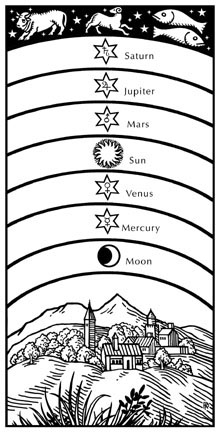
The book argues that Lewis secretly based the Chronicles of Narnia on the seven heavens of the medieval cosmos.
What are the seven heavens?
According to astronomers before Copernicus in the sixteenth century,
the seven heavens contained the seven planets which revolved around
Earth and exerted influences over people and events and even the metals
in the Earth's crust. The seven planets of the old cosmology included the Sun (Sol) and the
Moon (Luna), which we now don't regard as planets at all. The other
five were Mercury, Venus, Mars, Jupiter, and Saturn.
Why was Lewis so interested in the planets?
Because he regarded them as 'spiritual symbols of permanent value'
which were 'especially worthwhile in our own generation' (this is how
he wrote about them when introducing his long 1935 poem, 'The
Planets'). What made them so timely for his own generation was that
these spiritual symbols were headed by Jupiter (Jove), the kingly,
festive, and magnanimous planet. Lewis thought that his own generation
was too often 'Saturnocentric', that is, fixated upon Saturn, the
planet of calamity and misfortune and death. This fixation was no
surprise because his own generation had been, as he put it, 'born under
Saturn'; many of his contemporaries had been doomed to die in the Great
War. But that was an historical accident, not an eternal truth about
the nature of the universe. The qualities associated with Jupiter
were, he thought, a better representation of the heart of spiritual
reality. The hierarchical order of the planets, in which Jupiter was
enthroned as king over the other six, was a useful reminder of this
heart. 'Of Saturn we know more than enough,' he wrote, 'but who does
not need to be reminded of Jove?'
|
 |
Isn't astrology incompatible with Christianity?
It depends what you mean by 'astrology'. If you mean 'worshipping the
planets' or 'regarding the planetary influences as determinative',
then, yes, astrology is unChristian. But 'astrology' doesn't
necessarily mean either of those things. Literally, astrology means
'study of the stars', and there is nothing dangerous, wrong, or foolish
about studying God's creation.
Although the Bible outlaws worship of the 'host of heaven' (see for
example, Deuteronomy 4:19; 2 Kings 17:16; Job 31:26f; Jeremiah 8:2),
the Bible also allows that the stars have spiritual significance, which
is to be respected, studied, and, indeed, acted upon. The stars
proclaim the glory of God, according to the nineteenth psalm (Lewis's
favourite), a psalm which St Paul quotes (Romans 10:18) in order to
demonstrate how the Gentiles have already heard the preaching of
Christ. The Magi who followed the Star of Bethlehem to the birthplace
of Christ clearly understood this (Matthew 2:2, 9-10).
Throughout the Bible the stars are seen as 'signs' (Genesis 1:14;
Jeremiah 10:2; Matthew 24:29). Interpretation of these signs is
depicted negatively in Isaiah (47:13) and Daniel (1:20; 2:27; 4:7), but
only because it was practised by heathens for godless ends, not because
such astrological enquiry was considered evil or dangerous per se. Go here for more on this question and other common questions that have been asked about the book.
Almost every Lewis scholar who has read the book at least generally agrees with its thesis. You can read some of the reviews here: http://www.planetnarnia.com/planet-narnia/reviews
The only critic I can find who has read the book and has offered substantial criticism against its thesis is Devin Brown. You can read a discussion between him and Michael Ward (as well as other forum members) on NarniaWeb.
Hugh Hewitt had Michael Ward in studio to talk about the book, and you can listen to that interview here.
Posted in Interviews, Main Page, Religion (General), Roger's Posts No Comments »
In Egypt and elsewhere in the Muslim world, women suffering under oppressive leaders are starting to cry out for the right to choose. A quote from an AP article reveals the anguish of these women:
“How many times have I wished I were a man . . . [When the leader said he would continue to restrict women’s choice,] he saddened and hurt me,” wrote [a woman in an online forum] who said she listened to the speech 10 times. “I felt that my heart was about to explode in my chest . . . I am powerless.”
This is nothing but a power play on the part of these sexist leaders to keep women down by denying them the right to do what they want with their own bodies. We know, as Americans, how sacred the right to choose is. This is the most fundamental right necessary to ensure equal participation for women in their communities. You just
heard for yourself in the above quote about the emotional hardships this lack of choice is causing for women. We can’t just sit here and allow this to happen! Now is the time to stand up and be true to our most precious American value. We have an obligation to work together to raise the status of these women by removing this barrier to bodily sovereignty because we know that nothing is more important than the right to choose.
At least the women there are starting to wake up and speak for themselves:
A’eeda Dahsheh is a Palestinian mother of four in Lebanon who said she supports al-Zawahri [and his denial of a woman’s right to choose al-Qaida] and has chosen to raise children at home as her form of jihad. However, she said, she also supports any woman who chooses instead to take part in terror attacks.
Oh, wait . . . it matters what the choice is about?
Posted in Amy's Posts, Ethics, Main Page, Politics No Comments »
May 23, 2008 Posted by Roger OvertoncloseAuthor: Roger Overton
Name: Roger Overton
Email: rogeroverton@hotmail.com
Site: http://ateamblog.com
About: Roger Overton is currently pursuing a Masters degree at Talbot School of Theology. He has addressed various churches, schools and youth camps throughout the United States. Roger was co-editor of The New Media Frontier (Crossway, 2008) and God and Governing (Wipf & Stock, 2009).
Roger can be emailed at rogeroverton@hotmail.com.See Authors Posts (570)
Berny has recently concluded an 8 post summary/review of David Well's The Courage To Be Protestant. You can read my interview with Wells about the book here (part 1) and here (part 2).
Unlike every other summer, Hollywood is giving us a bunch of sequels this summer (yes, that was sarcasm). We've all seen ads for Caspian, Indy, The Dark Knight, and perhaps even Hellboy. But there's one popular sequel I actually had to seek out information for, and even then I couldn't find much. Did you know there's an X-Files sequel coming in July? The truth is out there…
Speaking of Prince Caspian, here's something I said 4 years ago about Disney producing the series: “My fear has been, since Disney bought the film, that they will attempt
to di-Christianize it as much as possible. Aslan will be a nice cuddly
lion who prances around singing about the circle of life and telling
the children to follow their hearts.” Prince Caspian was a good film, but it's a step away from the King of Kings toward the Lion King. That's my brief review. My co-editor John Mark Reynolds thought the movie was better than the book, and I agree that in some ways it is. However, I'm more inclined to agree with Lewis scholar Bruce Edwards that the movie was missing the best parts of the book. Bruce also has a great post explaining what is good about Prince Caspian (the book).
Evangelical Outpost recently held a symposium on how new media will affect the Christian message. There are some good essays to read there, and they even gave away a few copies of The New Media Frontier. Lucky folks!
If you're in Southern California, you'll probably want to check out a free event at Biola Tuesday, May 27th. Lee Strobel will be there promoting his new DVD: The Case for Christ (based on the book, of course). Perhaps the best part- they'll be giving out the DVD for free! Get the details here.
Posted in Main Page, Miscellaneous, Roger's Posts No Comments »
May 16, 2008 Posted by David N closeAuthor: David N
Name:
closeAuthor: David N
Name:
Email: dvnilsen@gmail.com
Site: http://reasonfromscripture.blogspot.com
About: In 2003 I graduated from high school with no set direction for my life. I spent a year in Iowa before returning to California to attend Junior College. I changed majors 3 times; from Physics to Business to Film (as you can see, no direction). I was a Christian, attending church regularly, but furthering the cause of Christ in this fallen world was not a high priority.
In 2005 I picked up an issue of TableTalk magazine, and I was re-introduced to the work of R. C. Sproul (whom I had read once in high school). Later that year, while taking a biology class with an ardent atheist professor, I picked up a copy of Lee Strobel's "The Case For A Creator." In the Fall of 2006 I came to Biola University and was introduced to the works of J. P. Moreland and John Mark Reynolds. My fate was sealed.
Just a few years ago, I was passionless. Now I have two passions: Studying the Word of God and engaging in the task of Apologetics. 1 Peter 3:15 exhorts all Christians to be ready to give an answer for the hope that we have. My goal is to be able to give my answer articulately and powerfully, but even more importantly, in love. There are many purposes for apologetics, but by far the most important is the opening of minds and the softening of hearts for the work of the Holy Spirit. If we don't care about and pray for those with whom we engage in apologetics, we fail to fulfill this purpose. As a wise man once said, "Take a stand for the Truth, but do it in love fool!"
Education Info:
--Currently: M.A. in Historical Theology student, Westminster Seminary California
--2008: B.A. in Philosophy, Biola University
--2006: A.A. in Liberal Arts, Palomar CollegeSee Authors Posts (75)
In response to Wielenberg's first argument, it seems perfectly reasonable for the Theist to assert two propositions. The first being that it is impossible for God’s character to be different than it is, and the second being that it is impossible to actually change the nature of moral perfection, as the evil contestant does in Wielenberg’s story. The second claim rests on the first. God’s character simply is the definition of moral perfection, and if His character cannot change, than neither can moral perfection. But to the first proposition Wielenberg might ask why God’s character cannot change. The response is simple, because if it did, then He would cease to be morally perfect, and thus cease to be God. At this point, Wielenberg might accuse the Theist of a contradiction. If God’s character cannot change without ceasing to be morally perfect, then isn’t there some outside standard to which we are holding God’s character? To this the Theist may reply that God’s character is indeed the only standard of perfection, and that all things are either good or bad based on their relation to Him alone, but that His character, being what it is, cannot be otherwise. It is simply a brute fact of the universe. For God is the ground of all being, the source and foundation for all reality. He simply is. And he could not be otherwise. If Wielenberg still wishes to object to this claim, then the Theist can quickly remind him that this is precisely what he wishes his reader to believe about the brute moral facts of the universe. Indeed, this is the thesis of his book! Moral facts such as “it is wrong to torture babies for fun” are, according to Wielenberg, real moral entities that exist and simply cannot be otherwise. But as far I can tell, there is no reason to believe that brute moral facts cannot change and not believe that God’s character cannot change. Thus, for Wielenberg to reject the Dependency Thesis for this reason would also be for him to reject his own moral theory.
For the second argument, I believe that two possible responses are open to the Theist. First, it can be argued that since a thing’s nature is given to it by God, it is still possible for something to be either good or evil by virtue of its nature, even though God indirectly made it so. Taking the example of falling in love, a Theist might say that falling in love is most certainly an instance of intrinsic good, its very nature is simply and completely good, but that because its nature was given to it by God, it is ultimately God that has, in a sense, “declared” it to be what it is. It sounds to me as though Wielenberg’s argument is actually saying, “nothing can be good in virtue of its nature because God gave it its nature.” But of course that doesn’t follow. What Wielenberg is really attacking is the notion that falling in love is not good for its own sake, but that it is good because God told us so. What he overlooks is the simple solution that God “told us so” by giving it a nature that was either good or evil.
However, there is another response that seems perfectly reasonable to me, namely that the Theist simply accepts that nothing actually is intrinsically good or evil apart from God. Why is suffering evil? Because God doesn’t want his creatures to suffer. Why is falling in love good? Because God wants us to be happy, and in part because it facilitates the creation of families, children, and society. Wielenberg is relying on the unshakable intuition that pain is evil in and of itself. It is better to keep this obvious truth than to accept a theory that rejects it. But isn’t it just as likely that the unshakable intuition in question is merely that pain is evil, leaving entirely open the question of why or how it is evil? This seems more plausible to me.
Posted in Book Reviews, David's Posts, Ethics, Main Page, Theology 9 Comments »
May 15, 2008 Posted by David NcloseAuthor: David N
Name:
Email: dvnilsen@gmail.com
Site: http://reasonfromscripture.blogspot.com
About: In 2003 I graduated from high school with no set direction for my life. I spent a year in Iowa before returning to California to attend Junior College. I changed majors 3 times; from Physics to Business to Film (as you can see, no direction). I was a Christian, attending church regularly, but furthering the cause of Christ in this fallen world was not a high priority.
In 2005 I picked up an issue of TableTalk magazine, and I was re-introduced to the work of R. C. Sproul (whom I had read once in high school). Later that year, while taking a biology class with an ardent atheist professor, I picked up a copy of Lee Strobel's "The Case For A Creator." In the Fall of 2006 I came to Biola University and was introduced to the works of J. P. Moreland and John Mark Reynolds. My fate was sealed.
Just a few years ago, I was passionless. Now I have two passions: Studying the Word of God and engaging in the task of Apologetics. 1 Peter 3:15 exhorts all Christians to be ready to give an answer for the hope that we have. My goal is to be able to give my answer articulately and powerfully, but even more importantly, in love. There are many purposes for apologetics, but by far the most important is the opening of minds and the softening of hearts for the work of the Holy Spirit. If we don't care about and pray for those with whom we engage in apologetics, we fail to fulfill this purpose. As a wise man once said, "Take a stand for the Truth, but do it in love fool!"
Education Info:
--Currently: M.A. in Historical Theology student, Westminster Seminary California
--2008: B.A. in Philosophy, Biola University
--2006: A.A. in Liberal Arts, Palomar CollegeSee Authors Posts (75)
In Chapter Two of Value And Virtue In A Godless Universe, Erik Wielenberg introduces two theses that he believes implicitly support Divine Command Theory. The first is the Control Thesis which states that “every logically consistent ethical claim, E, is such that God could make E true.” The second is the Dependency Thesis which states that “every true ethical claim is true in virtue of some act of will on the part of God.” Essentially, the great difference between these two is that in the former God creates ethics (by divine fiat we might say), while in the later ethics is based upon and originates from God’s nature or character. From this, Wielenberg distinguishes between two forms of Divine Command Theory. The first or “strong” form accepts both the Control and Dependency Thesis, while the “weak” form accepts only the Dependency Thesis.
It is important to consider Wielenberg’s objection to the strong form of Divine Command Theory first (which is essentially an objection to the Control Thesis), since it will play a role in his objection to the weak form. He objects to the strong form by way of an illustration. He asks us to imagine a competition in which the prize is omnipotence. One contestant is a very good person, while the other is very evil. Suppose, he says, that the evil person wins the contest and gains omnipotence. According to the Control Thesis, the evil contestant can now make it such that all of the evil acts he intends to perform (mass slaughter of innocents, torture, etc.) are actually very good. Moreover, he can make it such he is now a morally perfect being, not by changing himself, but by changing the nature of moral perfection. Thus, in the end, evil becomes good and the killing and torture of innocent people is morally commendable. Wielenberg relies primarily on intuition to argue that “there is simply no amount of power that would enable a being to make that true.” He further argues that “This story seems to get things backwards by making morality subject to power.” Fair enough. Our moral intuitions certainly do seem to suggest to us that no amount of power could make such atrocities good. We want to argue, especially as Christians, that morality is somehow objective and fixed, and that it could not be otherwise. At least on the surface, Wielenberg’s argument seems to offer convincing reasons to reject the Control Thesis on just such grounds. And so, for the sake of argument, we will grant him his conclusion.
Now Wielenberg turns his philosophical gun on the weak form of Divine Command Theory, specifically on the Dependency Thesis, which he states as follows, “It is still divine willing that determines which ethical claims are true, but the scope of divine willing is limited by the divine character.” In other words, God still retains the prerogative to say what things humans can and cannot do in certain times and places, but contra the Control Thesis He cannot command simply anything, but can only command those things which are in accordance with His own character, which sets the standard of moral goodness. Wielenberg proposes three objections to this thesis. First, he suggests that “implicit in the proposal is the notion that God has the power to make any logically consistent ethical claim true.” In the weak claim, God’s character prevents Him from making evil things good, but Wielenberg seems to be suggesting that the Control Thesis still manages to slip in the back door, and that we are left with the same problem, just moved back a step. If it were the case that God’s character turned out to be like the evil contestant in Wielenberg’s imaginary story, then even on the Dependency Thesis alone it would still be conceivable that God could make the slaughter of innocents a morally good thing. But Wielenberg has already refuted such a notion.
Wielenberg’s second objection to the Dependency Thesis is even stronger. He argues that an implication of the Dependency Thesis is that nothing is intrinsically good or evil. He says, “If an act of will on the part of God bestows value on something distinct from God, that value cannot be intrinsic.” By intrinsic value he means that a thing is valuable only in virtue of its nature. As an example of an intrinsic evil, he suggests pain. Pain is just bad, in and of itself, without reference to anything else. Conversely, falling in love is intrinsically good; it is simply good for its own sake. Following Chisholm, who argues that any theory of epistemology that doesn’t allow for obvious instances of knowledge should be rejected, Wielenberg suggests that any theory of morality that rejects something as obvious as the fact that some things are intrinsically good or evil should also be rejected.
What might the Christian say in response to these arguments? Tune in tomorrow!
Posted in Book Reviews, David's Posts, Ethics, Main Page, Theology 2 Comments »
May 8, 2008 Posted by David NcloseAuthor: David N
Name:
Email: dvnilsen@gmail.com
Site: http://reasonfromscripture.blogspot.com
About: In 2003 I graduated from high school with no set direction for my life. I spent a year in Iowa before returning to California to attend Junior College. I changed majors 3 times; from Physics to Business to Film (as you can see, no direction). I was a Christian, attending church regularly, but furthering the cause of Christ in this fallen world was not a high priority.
In 2005 I picked up an issue of TableTalk magazine, and I was re-introduced to the work of R. C. Sproul (whom I had read once in high school). Later that year, while taking a biology class with an ardent atheist professor, I picked up a copy of Lee Strobel's "The Case For A Creator." In the Fall of 2006 I came to Biola University and was introduced to the works of J. P. Moreland and John Mark Reynolds. My fate was sealed.
Just a few years ago, I was passionless. Now I have two passions: Studying the Word of God and engaging in the task of Apologetics. 1 Peter 3:15 exhorts all Christians to be ready to give an answer for the hope that we have. My goal is to be able to give my answer articulately and powerfully, but even more importantly, in love. There are many purposes for apologetics, but by far the most important is the opening of minds and the softening of hearts for the work of the Holy Spirit. If we don't care about and pray for those with whom we engage in apologetics, we fail to fulfill this purpose. As a wise man once said, "Take a stand for the Truth, but do it in love fool!"
Education Info:
--Currently: M.A. in Historical Theology student, Westminster Seminary California
--2008: B.A. in Philosophy, Biola University
--2006: A.A. in Liberal Arts, Palomar CollegeSee Authors Posts (75)
When it comes to the gender debate, we must always keep sight of the Biblical picture of leadership. Egalitarians frequently argue that our focus should not be on claiming our rights to authority over others, and I couldn’t agree more. They argue that we should focus on serving one another, and again I couldn’t agree more. But something that egalitarians would do well to remember is that true Biblical leadership is nothing more than the ultimate form of servanthood.
Christ has all power and authority and dominion over all the earth, and yet He humbled himself more than any human being possibly could. The same is true for those who are called to lead in Christ’s church. The powerful description of the way in which a husband is to love his wife (Ephesians 5) does not reveal some sort of egalitarian model of marriage, rather it reinforces the Biblical picture of true, Christ-like leadership. For a husband to take on the role of head of his wife is for him to give up his own desires for her sake. It is for him to always put her first, to always think of her before himself, and ultimately to give up his whole life for her (figuratively as well as in reality). This is not a command to “mutually submit.” Far from it. This is a command to be a true Christian leader, as Christ was, and is, and ever will be.
Posted in David's Posts, Gender Issues, Main Page, Theology No Comments »
May 6, 2008 Posted by David NcloseAuthor: David N
Name:
Email: dvnilsen@gmail.com
Site: http://reasonfromscripture.blogspot.com
About: In 2003 I graduated from high school with no set direction for my life. I spent a year in Iowa before returning to California to attend Junior College. I changed majors 3 times; from Physics to Business to Film (as you can see, no direction). I was a Christian, attending church regularly, but furthering the cause of Christ in this fallen world was not a high priority.
In 2005 I picked up an issue of TableTalk magazine, and I was re-introduced to the work of R. C. Sproul (whom I had read once in high school). Later that year, while taking a biology class with an ardent atheist professor, I picked up a copy of Lee Strobel's "The Case For A Creator." In the Fall of 2006 I came to Biola University and was introduced to the works of J. P. Moreland and John Mark Reynolds. My fate was sealed.
Just a few years ago, I was passionless. Now I have two passions: Studying the Word of God and engaging in the task of Apologetics. 1 Peter 3:15 exhorts all Christians to be ready to give an answer for the hope that we have. My goal is to be able to give my answer articulately and powerfully, but even more importantly, in love. There are many purposes for apologetics, but by far the most important is the opening of minds and the softening of hearts for the work of the Holy Spirit. If we don't care about and pray for those with whom we engage in apologetics, we fail to fulfill this purpose. As a wise man once said, "Take a stand for the Truth, but do it in love fool!"
Education Info:
--Currently: M.A. in Historical Theology student, Westminster Seminary California
--2008: B.A. in Philosophy, Biola University
--2006: A.A. in Liberal Arts, Palomar CollegeSee Authors Posts (75)
I was on facebook the other day, taking a silly quiz to see how “Reformed” I was. As it turns out, the quiz was designed by Presbyterians, so it wasn't very accurate.
One person, obviously irked by Reformation theology, left a rather cynical comment on the quiz's wall, along the lines of “child prostitution brings glory to God.” This person was attempting to raise the objection that, because the Reformed believe quite strongly that every event and every moment of history is ordained by God, for the purpose of glorifying Himself, they are left with the (supposedly) absurd conclusion that the most vile and wicked acts imaginable are somehow God-glorifying. Child prostitution exists, according to this line of thought, because God in some sense wanted it to.
I just want to say two things in response to this. The first is that, as is often the case, this is a stilted charicature of Reformed theology. No sane Reformed person actually believes that God possesses a disposition such that He actually delights in suffering. There is a very real sense in which God does not want anyone to suffer, in this life or in the next. He justly hates evil in every possible sense. You'll also be hard pressed to find a Reformed theologian who will claim that the Fall (and the subsequent existence of sin and evil in the world) was somehow necessary. What you will find is a commitment to the idea that, even though evil things are evil in and of themselves, and should not be considered good in any way, it must be the case that they exist for the good, or God would not allow them. I think Reformed and non-Reformed alike should be able to agree on this. The only other option is that God does not work all things for good (even if only the best good possible).
The second point is very important, and too often overlooked. Typically it is said that Reformed theology places the ultimate blame on God, while Arminian forms remove from Him any such responsibility and place it back on us. Here's the problem: Both views must account for vile atrocities like child prostitution. And both views believe in an omnipotent and wholly good God. In short, both must still account for the problem of evil. But to simply say, “well, it's human freedom” does little to get God off the hook. At the heart of the so-called “free will defense” against the problem of evil is the notion that the free choice to love God is so infinitely beautiful and good that it is worth the price of child prostitution. This is, to say the least, a contentious claim. But more importantly, most advocates of this view will also argue that such free choices of love are supremely God-glorifying. Arminian theology doesn't glorify man by placing all the emphasis on him and his choices, says the Arminian, but rather it places equal emphasis on God and His glory. Fair enough. But notice what the Arminian view is now saying: God “allows” (rather than “ordains”) child prostitution so that some can freely choose Him, to the end of glorifying Himself. Does that sound familair?
My point here is not necessarily to defend one view over the other. I don't think I've made any case for Reformed theology here. But we need to stop acting as though any one denomination has the sure-fire, bullet-proof response to something as immensely troubling and difficult as the problem of evil. I don't hold to Reformed theology because I think it makes more sense of the problem of evil than Arminian theology, and I would strongly discourage anyone from holding to Arminian theology for the same reason. If you can't accept Reformed doctrine because of exegetical concerns, or because you think it has no adequate grounding for moral responsibility, great! All I wish to submit here is that the mere presence of evil in the world is not by itself sufficient grounds for accepting or rejecting either view. It is, as they say, a two-way street.
Posted in Apologetics, David's Posts, Main Page, Theology No Comments »
May 4, 2008 Posted by David NcloseAuthor: David N
Name:
Email: dvnilsen@gmail.com
Site: http://reasonfromscripture.blogspot.com
About: In 2003 I graduated from high school with no set direction for my life. I spent a year in Iowa before returning to California to attend Junior College. I changed majors 3 times; from Physics to Business to Film (as you can see, no direction). I was a Christian, attending church regularly, but furthering the cause of Christ in this fallen world was not a high priority.
In 2005 I picked up an issue of TableTalk magazine, and I was re-introduced to the work of R. C. Sproul (whom I had read once in high school). Later that year, while taking a biology class with an ardent atheist professor, I picked up a copy of Lee Strobel's "The Case For A Creator." In the Fall of 2006 I came to Biola University and was introduced to the works of J. P. Moreland and John Mark Reynolds. My fate was sealed.
Just a few years ago, I was passionless. Now I have two passions: Studying the Word of God and engaging in the task of Apologetics. 1 Peter 3:15 exhorts all Christians to be ready to give an answer for the hope that we have. My goal is to be able to give my answer articulately and powerfully, but even more importantly, in love. There are many purposes for apologetics, but by far the most important is the opening of minds and the softening of hearts for the work of the Holy Spirit. If we don't care about and pray for those with whom we engage in apologetics, we fail to fulfill this purpose. As a wise man once said, "Take a stand for the Truth, but do it in love fool!"
Education Info:
--Currently: M.A. in Historical Theology student, Westminster Seminary California
--2008: B.A. in Philosophy, Biola University
--2006: A.A. in Liberal Arts, Palomar CollegeSee Authors Posts (75)
Why is it that those who borrow 99% of their ideas from Plato, Augustine and Aquinas are “sheep”…
while those who borrow 99% of their ideas from Nietzsche, Marx and Freud are “free thinkers”?
Posted in David's Posts, Main Page 3 Comments »
May 2, 2008 Posted by Roger OvertoncloseAuthor: Roger Overton
Name: Roger Overton
Email: rogeroverton@hotmail.com
Site: http://ateamblog.com
About: Roger Overton is currently pursuing a Masters degree at Talbot School of Theology. He has addressed various churches, schools and youth camps throughout the United States. Roger was co-editor of The New Media Frontier (Crossway, 2008) and God and Governing (Wipf & Stock, 2009).
Roger can be emailed at rogeroverton@hotmail.com.See Authors Posts (570)
Quenching God's Oracles: The Condemnation of Montanism in Four Parts
Part 4: Conclusion
Previous Parts:
Part 1: Introduction & History of Montanism
Part 2: The Beliefs of the Montanists
Part 3: The Condemnation of the Montanists
Posted in Main Page, Roger's Posts, Theology 8 Comments »



 content rss
Recent Comments