 October 3, 2009 Posted by David N
 closeAuthor: David N
Name:
closeAuthor: David N
Name:
Email: dvnilsen@gmail.com
Site: http://reasonfromscripture.blogspot.com
About: In 2003 I graduated from high school with no set direction for my life. I spent a year in Iowa before returning to California to attend Junior College. I changed majors 3 times; from Physics to Business to Film (as you can see, no direction). I was a Christian, attending church regularly, but furthering the cause of Christ in this fallen world was not a high priority.
In 2005 I picked up an issue of TableTalk magazine, and I was re-introduced to the work of R. C. Sproul (whom I had read once in high school). Later that year, while taking a biology class with an ardent atheist professor, I picked up a copy of Lee Strobel's "The Case For A Creator." In the Fall of 2006 I came to Biola University and was introduced to the works of J. P. Moreland and John Mark Reynolds. My fate was sealed.
Just a few years ago, I was passionless. Now I have two passions: Studying the Word of God and engaging in the task of Apologetics. 1 Peter 3:15 exhorts all Christians to be ready to give an answer for the hope that we have. My goal is to be able to give my answer articulately and powerfully, but even more importantly, in love. There are many purposes for apologetics, but by far the most important is the opening of minds and the softening of hearts for the work of the Holy Spirit. If we don't care about and pray for those with whom we engage in apologetics, we fail to fulfill this purpose. As a wise man once said, "Take a stand for the Truth, but do it in love fool!"
Education Info:
--Currently: M.A. in Historical Theology student, Westminster Seminary California
--2008: B.A. in Philosophy, Biola University
--2006: A.A. in Liberal Arts, Palomar CollegeSee Authors Posts (75)
Let us read the Bible then — if we can. But can we? The truth is that many of us have lost the ability to read the Bible. When we open our Bibles, we do so in a frame of mind which forms an insuperable barrier to our ever reading it at all. This may sound startling, but it is not hard to show that it is true.
When you sit down to any other book, you treat it as a unit. You look for the plot, or the main thread of the argument, and follow it through to the end. You let the author’s mind lead yours. Whether or not you allow yourself to “dip” before settling down to the book properly, you know that you will not have understood it till you have been through it from start to finish, and if it is a book that you want to understand you set aside time to read it in full. But when we come to Holy Scripture, our behaviour is different. In the first place, we are in the habit of not treating it as a book — a unit — at all, but simply as a collection of separate stories and sayings. We take it for granted before we look at the text that the burden of them — or, at least, of as many of them as affect us — is either moral advice or comfort for those in trouble. So we read them (when we do) in small doses, a few verses at a time. We do not go through individual books, let alone the two complete Testaments, as a single whole. We browse through the rich old Jacobean periods of the Authorised Version, waiting for something to strike us. When the words bring to our minds a soothing thought or a pleasant picture, we feel that the Bible has done its job for us. It seems that the Bible is for us not a book, but a collection of beautiful and suggestive snippets, and it is as such that we use it. The result is that we never read the Bible at all. We take it for granted that we are handling Holy Writ in the truly religious way; but in truth, our use of it is more than a little superstitious. It is the way of natural religiosity, perhaps, but not of true religion.
Could be this be one of the primary causes for the current state of theological disarray in evangelicalism? Have we forgotten how to read the ‘Good Book’ as a book? The Gospel is, after all, a story.
 Posted in David's Posts, Poetry/Scripture/Liturgy/Etc.
  No Comments »
September 28, 2009 Posted by Roger Overton closeAuthor: Roger Overton
Name: Roger Overton
closeAuthor: Roger Overton
Name: Roger Overton
Email: rogeroverton@hotmail.com
Site: http://ateamblog.com
About: Roger Overton is currently pursuing a Masters degree at Talbot School of Theology. He has addressed various churches, schools and youth camps throughout the United States. Roger was co-editor of The New Media Frontier (Crossway, 2008) and God and Governing (Wipf & Stock, 2009).
Roger can be emailed at rogeroverton@hotmail.com.See Authors Posts (570)
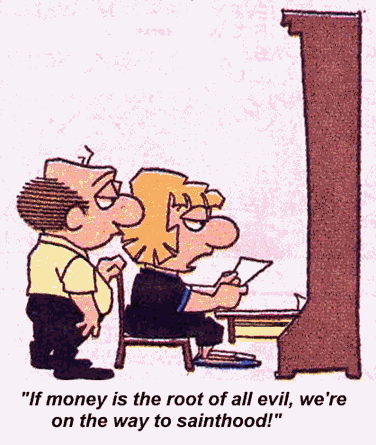 For the longest time I had an adverse gut reaction every time I read or heard the word “saint.” It was associated in my mind completely with the Roman Catholic model of sainthood, which I understood to be akin to idolizing people because of their good works. On one hand, this isn’t really a fair idea of the Roman Catholic view of sainthood, and more importantly, my adverse reaction stunted my understanding of what a saint is according to the Bible.
The closest thing to a proper definition of “saint” in the Bible may be 1 Cor. 1:2. Paul wrote, “To the church of God that is in Corinth, to those sanctified in Christ Jesus, called to be saints together with all those who in every place call upon the name of our Lord Jesus Christ, both their Lord and ours.” This is one of those instances where the Greek makes things really interesting. “Sanctified” is hagiazō and “saint” is hagios, meaning “make holy” and “holy” respectively. In other words, Paul was writing to those in Corinth (presumably all members of the Corinthian church) who had been made holy and were called to be holy.
Holiness is most simply being set apart. Just as God set apart Israel from all other nations and called them to be holy as He is holy (Lev 11:44), so God set apart the church, calling us to be holy as He is holy (1 Peter 1:16). Thus, the Dictionary of Biblical Imagery says “saint refers to the godly person whose spiritual and moral traits and behavior are what the Bible offers for approval and emulation.”
This actually isn’t very different from the Roman Catholic understanding. From Wikipedia: In his book, Making Saints: How the Catholic Church Determines Who Becomes a Saint, Who Doesn’t and Why, author Kenneth Woodward, notes the following: “A saint is always someone through whom we catch a glimpse of what God is like — and of what we are called to be. Only God ‘makes’ saints, of course. The church merely identifies from time to time a few of these for emulation. The church then tells the story. But the author is the Source of the grace by which saints live.”
The primary difference is the practice of veneration, or devotion to the saints. Though most Catholics don’t “worship” saints as they do God, many practice an extreme level of honor and respect given to their saints that often distracts from worship of God. It is one thing to emulate a more mature and sanctified believer, such as when Paul commanded believers to imitate him, but it is quite another to pray to a person or collect their artifacts (relics).
There is a lot of weight incorporated in the term “saint,” and that’s one of the reasons I think us Protestants should bring the term more into our regular vernacular. I believe God has called me to holiness, and through Christ I have been made holy (already and not yet), so I should refer to myself as a saint. Moreover, my brothers and sisters in Christ are also saints, and this standard for living a life set apart from the world is something we can hold each other accountable to. Perhaps calling each other saints, as the Bible does, will remind us of our calling and encourage us toward the goal for which God has called us heavenward.
Posted in Roger's Posts, Theology No Comments »
September 21, 2009 Posted by Roger OvertoncloseAuthor: Roger Overton
Name: Roger Overton
Email: rogeroverton@hotmail.com
Site: http://ateamblog.com
About: Roger Overton is currently pursuing a Masters degree at Talbot School of Theology. He has addressed various churches, schools and youth camps throughout the United States. Roger was co-editor of The New Media Frontier (Crossway, 2008) and God and Governing (Wipf & Stock, 2009).
Roger can be emailed at rogeroverton@hotmail.com.See Authors Posts (570)
I’m sure most of us have heard and sang the song “It is Well with My Soul.” The third verse always stands out to me, and for some reason was in my head all day after we sang it during Church on Sunday. In case you don’t recall it specifically, here’s the third verse:
My sin, oh, the bliss of this glorious thought!
My sin, not in part but the whole,
Is nailed to the cross, and I bear it no more,
Praise the Lord, praise the Lord, O my soul!
Regardless of our circumstance, this thought should certainly bring us much joy. What else in our world could matter more to us than that every awful wretched sin we’ve committed is no longer our burden? How could we not praise God for His great grace in swapping our sin with Christ’s righteousness?
What always strikes me about this verse is how the author, Horatio Spafford, was so caught in the bliss of this thought that he could not simply say his sin is nailed to the cross. It’s like when you’re trying to tell a friend about something great that happened to you and your words are racing through all sorts of details before you finally spill it out. Horatio Spafford’s level of excitement and joy over this thought so caused his words to overflow – he could not contain it. He starts to say something about his sin, but must pause to let us know how excited he is about this. He starts again, but must pause to clarify the scope and magnitude of what he’s describing.

What’s even more remarkable is the context in which this was written. Having already lost his only son in 1871 and had his livelihood destroyed by the Great Chicago Fire, Spafford planned to take his wife and four daughters to Europe. A business matter came up and he had to send his family ahead of him while he took care of it. The ship carrying them, the S.S. Ville du Havre, collided with a sailing ship and sank rapidly. All of his daughters died, and his wife sent him a telegram that simply said, “Saved alone.” Spafford was soon after able to follow his wife and meet up with her, but penned “It is Well with My Soul” as his shipped passed near where his daughters died. It’s worth noting that Spafford and his wife eventually moved to Jerusalem where they raised two more children and founded a mission for the poor.
The death of a single child can break a parent and has stressed some marriages to the point of divorce. Men often fall into the deepest of depressions when it seems all that they’ve worked for in a career has been wiped away to nothing. How does a man survive those events, in addition to the deaths of four more children, and pen a song that hold such excited bliss?
Brothers and sisters, only the rapturous love of God demonstrated so lavishly upon us by His grace through the atonement of our sins can produce in a man such steadfast and resilient joy. Only meditation on Christ’s shed blood for our souls can make even the deepest of sorrows caused by this world grow strangely dim.
Posted in Poetry/Scripture/Liturgy/Etc., Roger's Posts No Comments »
September 16, 2009 Posted by David NcloseAuthor: David N
Name:
Email: dvnilsen@gmail.com
Site: http://reasonfromscripture.blogspot.com
About: In 2003 I graduated from high school with no set direction for my life. I spent a year in Iowa before returning to California to attend Junior College. I changed majors 3 times; from Physics to Business to Film (as you can see, no direction). I was a Christian, attending church regularly, but furthering the cause of Christ in this fallen world was not a high priority.
In 2005 I picked up an issue of TableTalk magazine, and I was re-introduced to the work of R. C. Sproul (whom I had read once in high school). Later that year, while taking a biology class with an ardent atheist professor, I picked up a copy of Lee Strobel's "The Case For A Creator." In the Fall of 2006 I came to Biola University and was introduced to the works of J. P. Moreland and John Mark Reynolds. My fate was sealed.
Just a few years ago, I was passionless. Now I have two passions: Studying the Word of God and engaging in the task of Apologetics. 1 Peter 3:15 exhorts all Christians to be ready to give an answer for the hope that we have. My goal is to be able to give my answer articulately and powerfully, but even more importantly, in love. There are many purposes for apologetics, but by far the most important is the opening of minds and the softening of hearts for the work of the Holy Spirit. If we don't care about and pray for those with whom we engage in apologetics, we fail to fulfill this purpose. As a wise man once said, "Take a stand for the Truth, but do it in love fool!"
Education Info:
--Currently: M.A. in Historical Theology student, Westminster Seminary California
--2008: B.A. in Philosophy, Biola University
--2006: A.A. in Liberal Arts, Palomar CollegeSee Authors Posts (75)
At the Eastern Orthodox blog, The Well of Questions, blogger MG has been arguing for some time (most recently, here) that Protestants do not in fact believe that the church has any authority. Rather, we merely believe that the church has been right in those doctrines which it has affirmed at all times and in all places (the “catholic” faith) and that it is better to read the Bible in the light of tradition and the history of doctrine than in isolation. But, MG says, this only amounts to a belief that the church is accurate, not that it is authoritative. In order to be truly authoritative, MG contends that the church must have the inherent power to bind people’s consciences (in other words, an average Christian would be required to abide by the decisions of church councils and hierarchs, regardless of their personal opinion on the matter).
Why is this a problem for the Protestant? Well, frankly, for many Protestants it is no problem at all. Most evangelicals seem to assume that the “church” (which they rarely identify with any particular institution or denomination) has no authority whatsoever. The Pastor is equipped to teach his congregation because he usually knows more about the Bible (and therefore, in MG’s words, he would be more accurate in understanding it), but everyone’s opinion about Scripture is treated as equal. If a member of the congregation disagrees with the pastor there is little sense (if any) that he or she should submit to the Pastor’s judgment. And since so few evangelicals actually subscribe to any creed or confession, it becomes every person, Bible in hand, standing alone on equal interpretive ground.
Historic Protestants such as Lutheran and Reformed, however, would argue that the church does indeed have some measure of authority. Lutheran and Reformed denominations subscribe to creeds and confessions that all professing members must affirm. This is not because the creeds and confessions are believed to be infallible or on equal ground with the Bible. Rather, they are seen as binding because they were produced by official synods (or councils) of the church and are believed to accurately reflect what the Bible teaches. It is here that MG might point out my use of the word “accurately.” Indeed, we do believe that the church is accurate, but do we really believe, when the chips are down, that it has authority?
I would like to suggest that MG has set up something of a false dilemma here. It is true that Protestants do not believe that it is inherently a sin to disobey your pastor or synod, because we believe it possible that both could err. However, it does not follow from this that the church possesses no authority whatsoever. I would like to suggest that, in fact, accuracy produces authority. For example, a doctor is not inherently authoritative in medical matters because he is still human and can err in his diagnoses. However, his medical training makes him far more accurate at diagnosing, and with that accuracy comes a degree of authority over others who lack such training. We would be far wiser to accept the medical advice of a doctor over that of an accountant. This is not merely because the doctor is more accurate at diagnosing medical problems than the accountant, but because that accuracy grants the word of the doctor a level of authority that the accountant’s does not have.
This authority is a derivative authority, then, because it derives from the degree of accuracy that the church body has in interpreting Scripture (which means, of course, that the authority ultimately derives from Scripture). At this point the objection seems to be that the individual Christian is still granted a greater authority than the church, because he or she can simply choose to disobey the church if they feel that their own interpretation is better than the church’s. In such a case, however, I find it likely that the person does not truly believe that the church is accurate, let alone authoritative. If a person truly believes that his church (say, the PCA) is accurate in its interpretations of Scripture, then he ought to give her the benefit of the doubt and adopt an attitude of humility. This would be especially true for lay members of the congregation, who lack the theological training that their pastors and elders have. If a person’s conviction is unshakably strong and the issue is important enough, then they ought to concede that they do not truly believe that their church is on the whole accurate, and they should either find another church or continue to study and seek council from their elders. However, I’m confident that 99% of the time the issue can be resolved with humility. If a lay person (or even a clergyman) would simply adopt an attitude of humility and not immediately assume that they must always be right and everyone else (synod or not) be wrong, then there would be relatively few times in a person’s life where he or she would feel compelled to seriously disagree with their church.
The final question would seem to be, why should a Protestant ever adopt such a humble attitude? Why should a Protestant ever submit to a church’s decision on anything, when the church is not inherently more authoritative than the average lay person? Again, this question seems to presuppose that only an inherent authority can be real authority. But if indeed accuracy can bestow a derivative (and fallible) authority, and human beings are finite and fallen and therefore each individual cannot possibly know everything perfectly, it makes quite a lot of sense to speak of submitting to the church’s authority, even though that authority is neither inherent nor infallible.
If it is argued that the individual still has greater authority than the church because he or she can choose which church to follow and submit to in the first place, I would simply point out that the same is true for those who choose to follow either Rome or Constantinople.
Posted in David's Posts, Theology 2 Comments »
September 14, 2009 Posted by Roger OvertoncloseAuthor: Roger Overton
Name: Roger Overton
Email: rogeroverton@hotmail.com
Site: http://ateamblog.com
About: Roger Overton is currently pursuing a Masters degree at Talbot School of Theology. He has addressed various churches, schools and youth camps throughout the United States. Roger was co-editor of The New Media Frontier (Crossway, 2008) and God and Governing (Wipf & Stock, 2009).
Roger can be emailed at rogeroverton@hotmail.com.See Authors Posts (570)
As I’ve been reflecting on some of the great conversations that were had at the Christian Web Conference, I’ve been struck by the degree of confusion over what constitutes church and what church is to accomplish. Some believe church can be done online just as well as in person, while others hold that only through physical presence can the full intended expression of church be realized. Some argue that the purpose of church is to evangelize, while others contend the church’s primary responsibility is to its members. I say there’s confusion on these issues because I heard weak arguments for every position, but everyone seemed to hold their own view strongly regardless of the strength of their arguments.
I addressed some of these issues more than four years ago (The Purpose of the Church: What is it? And What is it for?), but obviously much more could and should be said. I’ve recently been helping my church formulate a statement of philosophy for cultural engagement and the issue of “who” church is for is something we’ve sought to state with strength and clarity. Mark Dever’s notes on The Pastor and His Community have been very helpful in formulating our position.
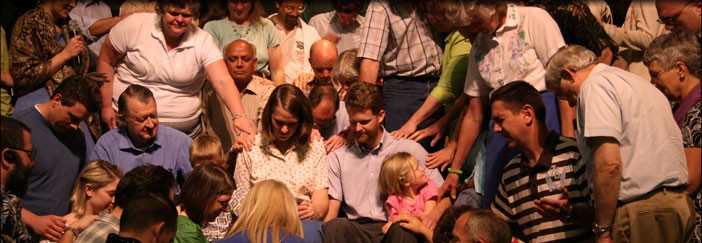 Simply put, we believe that Scripture directs the church to teach, admonish, encourage, discipline, support and care for its own members as its primary responsibility. If we are to answer whether church is for believers or non-believers, we will contend that its primary purpose is for believers. The vast majority of commands for the church as a body have to do with serving within and for the church body.
In caring for physical needs, our primary biblical responsibility is to those within our congregation (Matt 25:34-40; Acts 6:1-6; Gal 6:2, 10; James 2:15-16; 1 John 3:17-18). Though some of these texts are often used to support the notion that the church is called to take responsibility for the well-being of non-Christians around it, they clearly give priority to supporting members of the covenant community. Churches can provide aid to those in the surrounding community through mercy ministries as long as the gospel is not compromised nor its priority diminished, and only after it is clear that all known needs within the congregation that have been met.
It is interesting that the very practice of Christians loving other Christians (i.e. church being primarily about church members) is a form of evangelism. In John 17:20-23 Jesus prays that the world would know the Father sent Him because of the love and unity shown between the disciples. I think it’s fair to suggest that if we focus on evangelism without first prioritizing love among the brethren, our witness will be compromised.
This is one of those occasions where I am especially interested in hearing from readers who disagree with me. If you believe the Bible directs the church to be primarily for non-believers, please provide your case here.
Posted in Emerging / Emergent Church, Roger's Posts, Theology 1 Comment »
September 11, 2009 Posted by Roger OvertoncloseAuthor: Roger Overton
Name: Roger Overton
Email: rogeroverton@hotmail.com
Site: http://ateamblog.com
About: Roger Overton is currently pursuing a Masters degree at Talbot School of Theology. He has addressed various churches, schools and youth camps throughout the United States. Roger was co-editor of The New Media Frontier (Crossway, 2008) and God and Governing (Wipf & Stock, 2009).
Roger can be emailed at rogeroverton@hotmail.com.See Authors Posts (570)
Amy and I are tweeting live from www.christianwebconference.com. Apparently no one “live blogs” any more- we just tweet our notes- it’s more conversational. I tweeting on the @theateamblog account. Follow Amy @amy_k_hall.
Posted in Roger's Posts 4 Comments »
September 7, 2009 Posted by Roger OvertoncloseAuthor: Roger Overton
Name: Roger Overton
Email: rogeroverton@hotmail.com
Site: http://ateamblog.com
About: Roger Overton is currently pursuing a Masters degree at Talbot School of Theology. He has addressed various churches, schools and youth camps throughout the United States. Roger was co-editor of The New Media Frontier (Crossway, 2008) and God and Governing (Wipf & Stock, 2009).
Roger can be emailed at rogeroverton@hotmail.com.See Authors Posts (570)
For just $60 you can spend this Friday and Saturday with some of the top Christians in new media at the Christian Web Conference at Biola University. Speakers include Tim Challies, Andrew Jones, Joe Carter, John Mark Reynolds, Mark D. Roberts and many more. We’d like to see you there! Here’s the blurb:
The Christian Web Conference fosters community and learning through a combination of, idea roundtables sessions, and meal-time fellowshipping with web media experts. Attendees should expect to meet and interact with some of the top intellectual Christian web users in order to form friendships, learn how to improve their web media knowledge and ability from experts, and participate in vision casting for Christian use of web technologies. Ultimately, you should be a part of this conference because your brilliant ideas will be valued by others and because you can learn from the brilliant ideas of others. Your ideas and skills can help transform the way people use and think the web so come prepared to share and collaborate.
Go here to register.
Posted in New Media, Roger's Posts No Comments »
August 31, 2009 Posted by Roger OvertoncloseAuthor: Roger Overton
Name: Roger Overton
Email: rogeroverton@hotmail.com
Site: http://ateamblog.com
About: Roger Overton is currently pursuing a Masters degree at Talbot School of Theology. He has addressed various churches, schools and youth camps throughout the United States. Roger was co-editor of The New Media Frontier (Crossway, 2008) and God and Governing (Wipf & Stock, 2009).
Roger can be emailed at rogeroverton@hotmail.com.See Authors Posts (570)
Many of us have been led to believe that pride is the root of all sin, and we can find this notion in Christian literature at least as far back as St. Augustine. In essence, every sin can be reduced to some form of pride; an attempt to say to God, “I know better than you.” Augustine argued that it was pride at the core of Adam and Eve’s fall, and we can also likely agree that Satan’s fall from heaven involved pride. What I would like to suggest is not that we are wrong about sin always being a form of pride, but that this idea has distracted us from the virtuous form of pride.
I remember taking a class on Aristotle during my undergraduate studies and coming across his discussion of “magnanimity.” Unfortunately, I never really grasped what Aristotle meant by it, or why it might be worthwhile or even virtuous. Thankfully, I recently read a book that cleared it up in my mind: Introduction to Virtue Ethics by Raymond Devettere. He translates magnanimity as pride- a type of dignity or honor or confidence.
 What distinguishes sinful pride from virtuous pride is whether or not the pride is appropriate and whether it is directed at private or public recognition. Would we expect a runner who sets a new world record to be ambivalent or disappointed at their accomplishment? No, they should take pride in their accomplishment. But we would say it’s the wrong sort of pride if the champion went around rubbing his record in the face of other runners. Pride is a virtue only when it is directed at personal recognition for doing well or being virtuous (e.g. we can take pride in integrity).
Devettere puts it this way in summarizing Aristotle’s view: “The virtuous person honors oneself for his or her achievement in living a good life. Private recognition replaces public recognition, self-esteem replaces public esteem… The person who has achieved the greatest of great deeds-living a truly good life-caps the virtues integral to this life with the ultimate character virtue of pride. The virtuous person had to make many good decisions to become virtuous and is rightfully proud of having succeeded in life…
Being proud of our choices and of our life when it is predominantly a life of virtue is itself an important virtuous attitude because it reinforces the other moral virtues that are making our life a success. When we take pride in our work, we do it better; when we take pride in our lives, we live them better.”
If we have a choice between taking our car to a mechanic who doesn’t care about the quality of his work and one who takes pride in it, we will likely choose the prideful mechanic. We say he has pride not because he boasts in his ability to fix cars or proclaim his excellence over all other mechanics, but because he is diligent in his work such that he is mindful that he always does his best and knows that what he does is truly good.
As a younger Christian I was always bothered by what I thought was sinful pride or arrogance in Paul’s writings. He repeatedly tells people to imitate him. He powerfully asserts his authority over others. He speaks down to others who are less mature in their faith. What I failed to see is that his pride was appropriate and virtuous, and in itself something we ought to imitate. We ought to be so successful in following Christ that it is good for others to imitate us. We ought to respect spiritual authority and affirm and use it as necessary. We ought to challenge those with less spiritual maturity, which sometimes means using harsh or difficult words.
While I’m not sure if there’s a passage in the Bible that commends virtuous pride, I do believe that Paul modeled it for us, as well as Jesus and some of the prophets. We would do well to reflect on how we can use pride to improve our work habits, relationships and faith in Christ. Know that it is a good and virtuous thing to take pride in avoiding the sin of pride and pursuing holiness in Christ.
Posted in Ethics, Roger's Posts 1 Comment »
Obama’s health advisor, Ezekiel Emanuel, explains his philosophy on the kind of rules that ought to be created for health care rationing:
True reform, he argues, must include redefining doctors’ ethical obligations…. Dr. Emanuel argues that to make such [rationing] decisions, the focus cannot be only on the worth of the individual. He proposes adding the communitarian perspective to ensure that medical resources will be allocated in a way that keeps society going….
Dr. Emanuel concedes that his plan appears to discriminate against older people, but he explains: “Unlike allocation by sex or race, allocation by age is not invidious discrimination…. Treating 65 year olds differently because of stereotypes or falsehoods would be ageist; treating them differently because they have already had more life-years is not.”
The youngest are also put at the back of the line: “Adolescents have received substantial education and parental care, investments that will be wasted without a complete life. Infants, by contrast, have not yet received these investments…. As the legal philosopher Ronald Dworkin argues, ‘It is terrible when an infant dies, but worse, most people think, when a three-year-old dies and worse still when an adolescent does,’ this argument is supported by empirical surveys” (thelancet.com, Jan. 31, 2009).
Read the whole article in the Wall Street Journal.
This is not the government’s job. Bureaucrats with lists are not able to make good decisions for individuals far removed from them. They’re simply not connected to the situation. And it is certainly not the government’s job to determine which citizens have more “investments” in their lives and which have lived just about long enough and so are not as valuable to society. No entity with the power of law and police behind it should ever be given this kind of power.
And it gets worse because Emanuel’s ideas will also lead to less innovation:
He says the “major contributor” to rapid increases in health spending is “the constant introduction of new medical technologies, including new drugs, devices, and procedures…. With very few exceptions, both public and private insurers in the United States cover and pay for any beneficial new technology without considering its cost….”
If, in the future, the government controls the prices of health care, those prices will be artificially lowered as they currently are in governmental health care programs already in place. Right now, doctors make up the money they lose on these patients by charging everyone else more, but as soon as everyone is under artificially controlled prices, we will have fewer doctors (because the incentive to become a doctor will be lowered), fewer procedures to go around, and less innovation. The rationing will only get increasingly worse.
But I have to say that the most chilling part of all of this is the idea that doctors will cease to consider patients as individuals and start making decisions based on the good of the collective (not simply the good of other individual patients, but the good of “society”–that is, the state). They will be serving the state, not us. None of these things is a positive development.
Posted in Amy's Posts, Politics No Comments »
 Today is the big 2-5-0 for William Wilberforce. He’s been one of my most favorite people ever since I read his book, A Practical View of the Prevailing Religious System of Professed Christians, in the Higher and Middle Classes in This Country, Contrasted with Real Christianity (1797). Okay, yes, they had long titles back then. Now you can purchase it as A Practical View of Christianity. Not quite as descriptive, but still the same, wonderful book.
In honor of the day, please take a moment to check out this short biography of Wilberforce by John Piper. Listening to it is the best option (about an hour and a half), but you can also read the transcript. Here’s a taste:
What was the key to Wilberforce’s perseverance under these kinds of burdens and obstacles? One of the main keys was his child-like, child-loving, self-forgetting joy in Christ. The testimonies and evidence of this are many. A certain Miss Sullivan wrote to a friend about Wilberforce in about 1815: “By the tones of his voice and expression of his countenance he showed that joy was the prevailing feature of his own mind, joy springing from entireness of trust in the Savior’s merits and from love to God and man. . . . His joy was quite penetrating”. . . .
There was in this child-like love of children and joyful freedom from care a deeply healthy self-forgetfulness. Richard Wellesley, Duke of Wellington, wrote after a meeting with Wilberforce, “You have made me so entirely forget you are a great man by seeming to forget it yourself in all our intercourse.” The effect of this self-forgetting joy was another mark of mental and spiritual health, namely, a joyful ability to see all the good in the world instead of being consumed by one’s own problems (even when those problems are huge). James Stephen recalled after Wilberforce’s death, “Being himself amused and interested by everything, whatever he said became amusing or interesting. . . . His presence was as fatal to dullness as to immorality. His mirth was as irresistible as the first laughter of childhood”. . . .
In other words, his indomitable joy moved others to be good and happy. He sustained himself and swayed others by his joy. If a man can rob you of your joy, he can rob you of your usefulness. Wilberforce’s joy was indomitable and therefore he was a compelling Christian and Politician all his life.
Wilberforce’s amazing perseverance in ending the slave trade came in spite of human opposition and physical difficulties, and his drive to seek God continued in spite of the resistance of his own human fallenness. This is part of why I am so fascinated by Wilberforce. I can relate to a man who desires to know and love God more than anything, but who finds himself over and over again not using his time to the best advantage, and who regrets that he never seems to have the amount of time he needs to be alone with God. And I simply want to know how someone who had some of the same struggles I have not only persevered, but loved God to the end and lived a beautiful life in spite of it all, leaving the world a far better place than he found it.
In answer to this question, I can’t get this simple prayer, written in Wilberforce’s journal, out of my mind:
Resolved to lead a new life, adhering more steadfastly to my resolutions. Do thou, O God, renew my heart–fill me with that love of thee which extinguishes all other affections, and enable me to give thee my heart, and to serve thee in spirit and in truth.
Posted in Amy's Posts, Miscellaneous, The Christian Life No Comments »



 content rss
Recent Comments