November 30, 2009 Posted by Roger OvertoncloseAuthor: Roger OvertonName: Roger Overton Email: rogeroverton@hotmail.com Site:http://ateamblog.com About: Roger Overton is currently pursuing a Masters degree at Talbot School of Theology. He has addressed various churches, schools and youth camps throughout the United States. Roger was co-editor of The New Media Frontier (Crossway, 2008) and God and Governing (Wipf & Stock, 2009).
Roger can be emailed at rogeroverton@hotmail.com.See Authors Posts (570)
For much of December I’ll be posting a devotional commentary series through the song “O Holy Night.” It’s one of those traditional “Christmas” songs that I play all year round because it’s about so much more than a mere holiday. Almost every line of the song has something to do with the gospel. So I’ve broken up the three verses of the song into a twelve post series, making this post the first of thirteen. They’ll be posted every Monday, Wednesday, and Friday ending with Christmas.
The original “O Holy Night” was composed in French in 1847 by Adolphe Adam. He used the words from a French poem called “Minuit, chrétiens” (Midnight, Christians) by Placide Cappeau. It was translated into English 1855 and in 1906 became the first piece of music known to be broadcast on the radio.
Wikipedia lists two English versions on the carol, along with the original French and a more direct translation. I’ll be going through the first version since this is the one I’m most familiar with. Here’s the blog schedule:
Lastly, I thought it would be good to link to some of the performances of the song that are available. Interestingly, I couldn’t find anyone who sings the second verse. Some only sing the first verse and repeat it. Some change the last lines and simply sing noel. What strikes me is that many of the performers are not Christians (to my knowledge), yet they are proclaiming the good news. I wonder if any of them have given serious thought to the words they sing.
November 27, 2009 Posted by Roger OvertoncloseAuthor: Roger OvertonName: Roger Overton Email: rogeroverton@hotmail.com Site:http://ateamblog.com About: Roger Overton is currently pursuing a Masters degree at Talbot School of Theology. He has addressed various churches, schools and youth camps throughout the United States. Roger was co-editor of The New Media Frontier (Crossway, 2008) and God and Governing (Wipf & Stock, 2009).
Roger can be emailed at rogeroverton@hotmail.com.See Authors Posts (570)
I don’t typically review music since I’m not very skilled in music. However, when my church produces a Christmas album, I consider that a great opportunity to make an exception.
“So Much Joy” was released by Grace EV Free Church in La Mirada, CA just this week. It has 10 tracks, one of which is instrumental (Silent Night). While most of the songs are traditional (such as Joy to the World, What Child is This? and God Rest Ye Merry, Gentleman), many of them have been arranged in new ways by Walt Harrah. The one song that is completely new is the title track, “So Much Joy.”
Overall, this is a great Christmas album. It features many of the strengths in Grace’s musicians and vocalists. My favorite instrument, the violin, often gets significant play throughout the album. One of my standards for whether I like a particular version of Joy to the World is whether or not it makes me feel joyful- this one inspires much joy. So Much Joy is probably my favorite song on the album. There is one song I skip, “Children, Go.” It’s done well; I just don’t care for the song.
While you can download the album on iTunes, you can also listen to the entire album for free online. Check it out below, and visit www.SongsofGrace.org for more info about the album and our church.
I saw a disturbing play last weekend. It was disturbing because it spoke the truth about the condition of man. Extinctionis the story of two men who, for a decade since their friendship began in college, have met annually in Atlantic City to revel in all the drugs, gambling, and women the city has to offer. This year, however, things have changed. For the first man, an awareness of the inevitability of death causes him to grasp even more desperately at all the world has to offer while he still can; he knows of nothing greater to grasp for. And though the second man’s eyes have been opened to the fleeting nature of the pleasures of sin, and he has taken steps to create new, real, lasting life for himself, we see in his story the destructive power of past sins to reach into a man’s future, destroy any goodness it finds there, and drag him back by his own lusts.
The play told the truth. The ugliness of sin was neither hidden nor glorified, and the excuses made by the characters to justify their actions looked weak and pathetic. The emptiness of their previously wasted lives was made plain, and this, one of them lamented. The play spoke the truth about the slavery of sin. But it was not the whole truth. For that was where the play ended, without any hope of freedom in sight. The men were not capable of really escaping–sin was too powerful. The end.
And this is where the story would end for all of us were it not for God snatching us out of that living death, opening our eyes to His glory, revealing Himself to us, giving us new life. Like the men in the play, we were helpless and could not escape on our own, but God stepped in and changed everything. “Our old self was crucified with Him, in order that our body of sin might be done away with, so that we would no longer be slaves to sin.”
I thank God for the reminder of the slavery I’ve been rescued from, for the reminder of my desperate helplessness and need for Him, and for the reminder that there’s a whole world of people in slavery out there–people whose stories end in hopelessness because they don’t know about the One who conquered sin so that we could be free and have true life with Him. And they will never know about this hope unless we tell them. Their pain and need ought to drive everything we do.
For when you were slaves of sin, you were free in regard to righteousness. Therefore what benefit were you then deriving from the things of which you are now ashamed? For the outcome of those things is death. But now having been freed from sin and enslaved to God, you derive your benefit, resulting in sanctification, and the outcome, eternal life. For the wages of sin is death, but the free gift of God is eternal life in Christ Jesus our Lord.
Thank you for this gift I did not deserve, God. Thank you, thank you.
November 19, 2009 Posted by David NcloseAuthor: David NName: Email: dvnilsen@gmail.com Site:http://reasonfromscripture.blogspot.com About: In 2003 I graduated from high school with no set direction for my life. I spent a year in Iowa before returning to California to attend Junior College. I changed majors 3 times; from Physics to Business to Film (as you can see, no direction). I was a Christian, attending church regularly, but furthering the cause of Christ in this fallen world was not a high priority.
In 2005 I picked up an issue of TableTalk magazine, and I was re-introduced to the work of R. C. Sproul (whom I had read once in high school). Later that year, while taking a biology class with an ardent atheist professor, I picked up a copy of Lee Strobel's "The Case For A Creator." In the Fall of 2006 I came to Biola University and was introduced to the works of J. P. Moreland and John Mark Reynolds. My fate was sealed.
Just a few years ago, I was passionless. Now I have two passions: Studying the Word of God and engaging in the task of Apologetics. 1 Peter 3:15 exhorts all Christians to be ready to give an answer for the hope that we have. My goal is to be able to give my answer articulately and powerfully, but even more importantly, in love. There are many purposes for apologetics, but by far the most important is the opening of minds and the softening of hearts for the work of the Holy Spirit. If we don't care about and pray for those with whom we engage in apologetics, we fail to fulfill this purpose. As a wise man once said, "Take a stand for the Truth, but do it in love fool!"
Education Info:--Currently: M.A. in Historical Theology student, Westminster Seminary California
--2008: B.A. in Philosophy, Biola University
--2006: A.A. in Liberal Arts, Palomar CollegeSee Authors Posts (75)
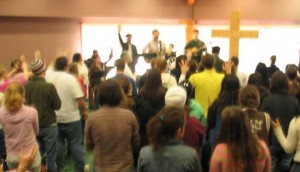
The earliest Protestant churches (the Reformed ones, not the Lutheran ones) sang only Psalms in their worship services, and they did so a capella (with no instrumental accompaniment). Here is a wonderful quotation from John Calvin on this subject (HT: The Heidelblog):
As for public prayers, there are two kinds: the one consists simply of speech, the other of song…And indeed, we know from experience that singing has great strength and power to move and to set on fire the hearts of men in order that they may call upon God and praise him with a more vehement and more ardent zeal. It is to be remembered always that this singing should not be light or frivolous, but that it ought to have weight and majesty…Now, what Augustine says is true, namely that no one can sing anything worthy of God that he has not received from him. Therefore, even after we have carefully searched everywhere, we shall not find better or more appropriate songs to this end than the Psalms of David, inspired by the Holy Spirit. And for this reason, when we sing them, we are assured that God puts the words in our mouth, as if he himself were singing through us to exalt his glory.
A minority of Reformed Protestants today lament the gradual decline of this form of worship in favor of hymn-singing with an organ or piano, and then the further decline into chorus-singing with guitars and many other instruments. They believe that this is not simply an issue of singing “popular” music instead of “sacred” music, but rather an issue of moving away from a view of worship in which every aspect is instituted by God. In theological terms, this is usually called the Regulative Principle of Worship (RPW): We may only do in worship that which is prescribed by God in Scripture. Luther, in contrast, held to the principle that we may do in worship whatever is not forbidden in Scripture. Despite the fact that most evangelicals today find their heritage in the 16th Century Reformed rather than Lutheran churches, they certainly follow Luther in their worship practices.
I don’t know what I think about this yet. I’m not convinced that instruments should be forbidden in worship, and many good Reformed scholars argue that instruments are merely a “circumstance” (like time, place, language, all of which can be changed without affecting the substance of worship), not an “essential” of worship. However, I see a lot of merit in the argument that we should try to only sing “inspired lyrics.” This includes more than Psalms, but also other poetry in the Bible, including the songs in the New Testament (such as those recorded in Luke, in Philippians 2, etc). And theoretically, any passage of Scripture could be worked into the form of a song.
On the other hand, the problem with this is that as soon as you change the format of the words of Scripture to make them actually work as a song, you have paraphrased, and paraphrasing is one of things that traditional RPW folk are objecting to (as one of my seminary profs told us, it was Jonathan Edwards’ paraphrases of the Psalms that were a “gateway drug” to uninspired hymns!). You can’t avoid this problem by going with only Psalms, because the Psalms were written in Hebrew. So, not only is every English translation a kind of paraphrase to begin with (to greater and lesser degrees, of course), but even the English translation cannot be taken straight out of most Bibles and set to music, they must be further re-phrased.
Still, Calvin makes a great point in the quote above, and we cannot deny that as hymns and praise songs have taken root in modern churches, Psalm-singing has almost totally disappeared. This is a sad thing, especially considering that the book of Psalms was the hymn book of the early church. If for no other reason, we should take these arguments very seriously, and not simply dismiss them out of hand.
November 16, 2009 Posted by Roger OvertoncloseAuthor: Roger OvertonName: Roger Overton Email: rogeroverton@hotmail.com Site:http://ateamblog.com About: Roger Overton is currently pursuing a Masters degree at Talbot School of Theology. He has addressed various churches, schools and youth camps throughout the United States. Roger was co-editor of The New Media Frontier (Crossway, 2008) and God and Governing (Wipf & Stock, 2009).
Roger can be emailed at rogeroverton@hotmail.com.See Authors Posts (570)
Tomorrow I’ll be on my way to the 2009 Annual meeting of the Evangelical Theological Society and Philosophical Society. Friday at 10am I’ll be presenting my paper:
“Virtues and the Case for Christ: Virtue Apologetics as the Connection between Character Development and Evangelism”
If you’re going to be at ETS, drop me a note or stop by and say hello!
October 26, 2009 Posted by Roger OvertoncloseAuthor: Roger OvertonName: Roger Overton Email: rogeroverton@hotmail.com Site:http://ateamblog.com About: Roger Overton is currently pursuing a Masters degree at Talbot School of Theology. He has addressed various churches, schools and youth camps throughout the United States. Roger was co-editor of The New Media Frontier (Crossway, 2008) and God and Governing (Wipf & Stock, 2009).
Roger can be emailed at rogeroverton@hotmail.com.See Authors Posts (570)
Looking around at many of the church buildings and facilities standing today, it seems that they either had not the money or interest in using architecture for more than building a roof. In fact, some church buildings are down right ugly, and one has to wonder what message these buildings communicate to the community around them. Is religion, or Christianity more specifically, just as old and irrelevant as these buildings?
Architect Mel McGowan has been advocating a different approach to church and ministry facilities, and he captures them in his book, Design Intervention: Revolutionizing Sacred Space. McGowan believes “Church environments can [use] concrete, paint, and landscaping to communicate the Gospel in new ways. This “architectural evangelism” still upholds excellence, but replaces intimidating experiences with inviting environments.” (7)
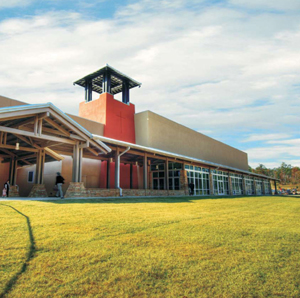
The book is in a sense a portfolio of McGowan’s work, though he uses his work as examples for how architecture can make a spiritual difference. It’s broken up into 5 chapters, each highlighting three of his projects with a number of pictures. I’ve included a couple here as samples. The first is of Heritage Christian Church in Georgia. “Today the Christ-centered community is re-centered near the water. The church worships in a simple pre-engineered structure detailed with elements inspired by Georgia State Park lodges, and a glass, stone, and wood gallery guides foot traffic along the water’s edge. God easily handles the wow factor, and the congregation enjoys closer connection to the Master Architect.” (57)
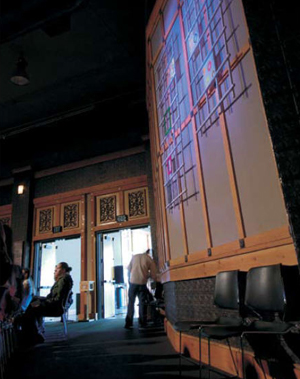
The second sample is from Rock Harbor in California. This is a church I’ve personally visited and can attest to the architectural brilliance and beauty it displays. Rock Harbor is located in an office park right next to Orange County airport. There’s little natural beauty around it. The building itself almost blends in as it looks like just another warehouse. But inside it’s a creative masterpiece. “Stewardship and creativity-values frequently held in a dichotomous relationship-are both communicated here throughout the environment. By clearly recycling and reusing materials and finishes normally considered unsuitable for sacred space, social and environmental values are linked to the spiritual one of vibrant, Christian community.” (23)
Design Intervention by Mel McGowan is a quick read with an important and substantive message. It’s of obvious use for those building or remodeling their church or ministry space, but I think it’s also helpful to anyone in leadership for reflecting on how they can best use the space God has given them for ministry. Design Intervention would make a great coffee table book that could even start a conversation about the gospel.
Design Intervention can be ordered through Amazon’s Marketplace for $19.99. It can also be ordered through the book’s website, but buyers should be warned that they may receive the slightly-less-sacred alternate title, Design Like God Gives a Damn.
October 19, 2009 Posted by Roger OvertoncloseAuthor: Roger OvertonName: Roger Overton Email: rogeroverton@hotmail.com Site:http://ateamblog.com About: Roger Overton is currently pursuing a Masters degree at Talbot School of Theology. He has addressed various churches, schools and youth camps throughout the United States. Roger was co-editor of The New Media Frontier (Crossway, 2008) and God and Governing (Wipf & Stock, 2009).
Roger can be emailed at rogeroverton@hotmail.com.See Authors Posts (570)
Amy and I are excited to be part of a new blog put together by Joe Carter at First Things. It’s called “Evangel,” and it’s meant to be a place where evangelical voices can be heard. Some of the great contributors include Justin Taylor, Russell D. Moore, John Mark Reynolds and Hunter Baker. Amy and I will definitely still be blogging here, but we also couldn’t pass up the opportunity to be a part of the Evangel project. Here’s the lead on my first post there:
Though still relatively young, I would like to think that I’ve grown and matured in my understanding and perspective on faith, theology and culture. I went through a phase in my life a few years ago when I was extremely particular about the views with which I associated myself. I wanted to make sure I was abundantly clear in not just affirming what I believed to be true (e.g. amillennialism), but also emphatically condemning what I opposed (premillennialism, dispensationalism, postmillennialism, pan-millennialism, etc.). As is typically the case with those whose primary epistemic purpose is the condemnation of opposing views, I at times condemned and excluded the people who held those views.
One of the casualties of this attitude was “evangelical.” Certainly there were good things meant by the term that I could affirm (such as Joe listed below), and there were many great men and women who could be described by it. But in my theological high tower I could only see the bad examples- instances of shallow or questionable teaching, Jesus merchandising, and uncreative cheesy music. So I found myself looking down on the entire term, movement and group.
October 13, 2009 Posted by Roger OvertoncloseAuthor: Roger OvertonName: Roger Overton Email: rogeroverton@hotmail.com Site:http://ateamblog.com About: Roger Overton is currently pursuing a Masters degree at Talbot School of Theology. He has addressed various churches, schools and youth camps throughout the United States. Roger was co-editor of The New Media Frontier (Crossway, 2008) and God and Governing (Wipf & Stock, 2009).
Roger can be emailed at rogeroverton@hotmail.com.See Authors Posts (570)
Twice a month my church gathers for Monday night prayer. This week one of the elders (Tim) led us through a wonderful script rooted in Psalm 11. It’s so good I decided to steal it and adapt it to a blog post
11:1 In the Lord I take refuge; how can you say to my soul, “Flee like a bird to your mountain,
2 for behold, the wicked bend the bow;
they have fitted their arrow to the string to shoot in the dark at the upright in heart;
3 if the foundations are destroyed, what can the righteous do?”
4 The Lord is in his holy temple; the Lord’s throne is in heaven; his eyes see, his eyelids test the children of man.
5 The Lord tests the righteous, but his soul hates the wicked and the one who loves violence.
6 Let him rain coals on the wicked; fire and sulfur and a scorching wind shall be the portion of their cup.
7 For the Lord is righteous; he loves righteous deeds; the upright shall behold his face.
Where do we run in times of trouble? What can we do?
1) Psalm 91 – Take Refuge in the Lord
Psalm 91:1 He who dwells in the shelter of the Most High will abide in the shadow of the Almighty.
2 I will say to the Lord, “My refuge and my fortress, my God, in whom I trust.”
3 For he will deliver you from the snare of the fowler and from the deadly pestilence.
4 He will cover you with his pinions, and under his wings you will find refuge;
his faithfulness is a shield and buckler. (more)
2) Hebrews 9:22-28 Remember that the Lord dwells in His holy temple
Heb 9: 24 For Christ has entered, not into holy places made with hands, which are copies of the true things, but into heaven itself, now to appear in the presence of God on our behalf. (more)
4) Psalm 139:1-18 Know that God sees all our situations
139:1 O Lord, you have searched me and known me!
2 You know when I sit down and when I rise up; you discern my thoughts from afar.
3 You search out my path and my lying down and are acquainted with all my ways.
4 Even before a word is on my tongue, behold, O Lord, you know it altogether. (more)
5) James 1:2-4 Recognize that God tests His children
James 1:2 Count it all joy, my brothers, when you meet trials of various kinds,
3 for you know that the testing of your faith produces steadfastness.
4And let steadfastness have its full effect, that you may be perfect and complete, lacking in nothing.
6) Psalm 37:1-17 Recognize that God hates the wicked & the violent
Psalm 37:10 In just a little while, the wicked will be no more; though you look carefully at his place, he will not be there.
11 But the meek shall inherit the land and delight themselves in abundant peace.
12 The wicked plots against the righteous and gnashes his teeth at him,
13 but the Lord laughs at the wicked, for he sees that his day is coming. (more)
7) Psalm 37:18-22 Remember that God will bring vengeance on the wicked
Psalm 37:20 But the wicked will perish; the enemies of the Lord are like the glory of the pastures; they vanish-like smoke they vanish away. (more)
8 ) Psalm 37:37-40 Rest in knowing that God is righteous & loves righteous deeds
Psalm 37:39 The salvation of the righteous is from the Lord; he is their stronghold in the time of trouble.
40 The Lord helps them and delivers them; he delivers them from the wicked and saves them, because they take refuge in him. (more)
9) Revelation 20:11-21:7 Look forward to beholding His face
Rev 21: 6 And he said to me, “It is done! I am the Alpha and the Omega, the beginning and the end. To the thirsty I will give from the spring of the water of life without payment.
7 The one who conquers will have this heritage, and I will be his God and he will be my son. (more)
October 6, 2009 Posted by Roger OvertoncloseAuthor: Roger OvertonName: Roger Overton Email: rogeroverton@hotmail.com Site:http://ateamblog.com About: Roger Overton is currently pursuing a Masters degree at Talbot School of Theology. He has addressed various churches, schools and youth camps throughout the United States. Roger was co-editor of The New Media Frontier (Crossway, 2008) and God and Governing (Wipf & Stock, 2009).
Roger can be emailed at rogeroverton@hotmail.com.See Authors Posts (570)
I just realized that I never got around to posting the endorsements we received for God and Governing: Reflections on Ethics, Virtue and Statesmanship. He are some of the great things that have been said about the book, which contains contributions from Dallas Willard, David Wells, Os Guinness and many more:
This collection of essays addresses the critical and perpetual questions of human society in a way that challenges both historic errors of Christian cultural and political engagement: complete withdrawal and utter accommodation. One of the most pressing issues in the evangelical world today is the right relationship between Christian ethics and secular law, and this volume makes a substantial contribution to the discussion.”
—Jordan J. Ballor
Associate Editor
Journal of Markets & Morality
“This wonderful collection of essays clearly shows that Evangelicals, contrary to the conventional wisdom, are fully prepared to enter into serious conversation with each other and their non-Evangelical neighbors on issues of government, religion, and the common good. In an age in which many militant secularists uncharitably paint all serious Christians as closet theocrats, this book shows once and for all that such a portrait is pretentious defamation in the cause of atheocratic utopianism.”
—Francis J. Beckwith
Professor of Philosophy and Church-State Studies
Baylor University
“When Jesus said, ‘Render unto Caesar . . .’ he acknowledged the realm of earthly government authority while at the same time demanding that we render ‘. . . unto God the things that are God’s.’ This timely book explores the tension generated when believers struggle to reconcile the moral law’s supremacy over temporal law with their own participation in the political realm. It’s a much needed reset button for those of faith involved in public policy.”
—Chuck DeVore
California State Assemblyman
“This book comes at just the right time, during my own first run for political office. It deals head on with the central spiritual challenge of doing so . . . This brief, compelling, almost-conversational book not only imparts wisdom, it draws out of the reader the personal convictions necessary to engage in both leading and serving others in government. If you hold elected office, are considering a run, or simply vote and care about our nation, I challenge you to take a fresh look at this God-ordained element of common grace through the pages of God and Governing.”
—Scott Ott,
Columnist, The Washington Examiner; Editor, ScrappleFace.com
October 5, 2009 Posted by Roger OvertoncloseAuthor: Roger OvertonName: Roger Overton Email: rogeroverton@hotmail.com Site:http://ateamblog.com About: Roger Overton is currently pursuing a Masters degree at Talbot School of Theology. He has addressed various churches, schools and youth camps throughout the United States. Roger was co-editor of The New Media Frontier (Crossway, 2008) and God and Governing (Wipf & Stock, 2009).
Roger can be emailed at rogeroverton@hotmail.com.See Authors Posts (570)
I suspect that most people, including most Christians, give more thought to specific individual beliefs they hold than to the complete picture their beliefs convey. This complete picture is a worldview- it’s the lid of the puzzle box showing us how each of our beliefs fit together (if they do). Regardless of how much we think of our worldviews, we all still hold them. We all see the world in some way and process the information through the beliefs we hold about it. Since we all have worldviews, it’s important for us to understand them and be able to judge whether or not we hold a good worldview.
A worldview is the set of beliefs a person holds. These beliefs can be something like, “I believe it was wrong for Luke and Leia to kiss in Star Wars because they’re siblings.” However, it also includes more subconscious beliefs most people don’t utter like, “I believe in the law of non-contradiction.” All of our life experiences are bound up in our worldview; it is incredibly difficult to escape seeing things through the belief system we already have in place. Worldviews act like glasses. If we wear red glasses, then everything we see is tinted red. If I try to be a consistent atheist, then I must see only an organized clump of cells when I look at other human beings. However, if I’m a Christian, then I see other human beings as valuable creatures made in the image of God.
Our postmodern culture would have us believe that no worldview or paradigm is better than another. Some tell us that since we cannot escape our worldviews, we cannot see if our worldview grants us more access to truth than others. This is of course self-refuting, since they posit their worldview (that we can’t tell which are better) as better than those that claim we can tell which are better.
So how do we tell? I believe there are three tools available to determine the validity of a worldview. (These are based on Ronald Nash’s great books Faith and Reason and Worldview in Conflict.)
1) Practice. Can we live out our worldview in the real world? Say someone believes all truths are socially constructed. In other words, they believe their community constructs truths true for them but not necessarily true for other people. When this person travels to the opposite end of the planet they will invariably drop at the sound of gunfire and look both ways when they cross the street. They cannot live consistently (for long) with their belief that truths are social constructs.
2) Experience. Do our beliefs resonate with what we experience in the real world? Hindus tell us that evil does not exist. However, this does not correspond with what most people encounter on a day-to-day basis. It’s hard to believe evil does not exist when we consider the Nazi gas chambers and Saddam’s torture chambers. Some worldviews don’t resonate with our experiences of the real world.
3) Logic. Are our beliefs logically consistent? Someone who says, “There is no truth,” fails this test since they believe “there are no truths” is true (it’s self-refuting). Each belief must be consistent with all other beliefs in the worldview.
Whatever worldview we hold must pass all three tests to provide us the greatest possible access to truth. The only perfect worldview is God’s, which we do not have. Our goal should be to continually reform our view to His. The Christian is the only person whose worldview corresponds to reality (experience), is coherent (logic), and is liveable (practice); and the standard for this worldview is the Bible.
How often we approach the throne of grace as desperate beggars. Yet He never once turns us away, but lavishes the richest of riches upon us. 2009-10-06
 November 30, 2009 Posted by Roger Overton

 Posted in Poetry/Scripture/Liturgy/Etc., Roger's Posts
  11 Comments »

 The earliest Protestant churches (the Reformed ones, not the Lutheran ones) sang only Psalms in their worship services, and they did so a capella (with no instrumental accompaniment). Here is a wonderful quotation from John Calvin on this subject (HT:
  The book is in a sense a portfolio of McGowan’s work, though he uses his work as examples for how architecture can make a spiritual difference. It’s broken up into 5 chapters, each highlighting three of his projects with a number of pictures. I’ve included a couple here as samples. The first is of Heritage Christian Church in Georgia. “Today the Christ-centered community is re-centered near the water. The church worships in a simple pre-engineered structure detailed with elements inspired by Georgia State Park lodges, and a glass, stone, and wood gallery guides foot traffic along the water’s edge. God easily handles the wow factor, and the congregation enjoys closer connection to the Master Architect.” (57)
 in an office park right next to Orange County airport. There’s little natural beauty around it. The building itself almost blends in as it looks like just another warehouse. But inside it’s a creative masterpiece. “Stewardship and creativity-values frequently held in a dichotomous relationship-are both communicated here throughout the environment. By clearly recycling and reusing materials and finishes normally considered unsuitable for sacred space, social and environmental values are linked to the spiritual one of vibrant, Christian community.” (23)
 A worldview is the set of beliefs a person holds. These beliefs can be something like, “I believe it was wrong for Luke and Leia to kiss in Star Wars because they’re siblings.” However, it also includes more subconscious beliefs most people don’t utter like, “I believe in the law of non-contradiction.” All of our life experiences are bound up in our worldview; it is incredibly difficult to escape seeing things through the belief system we already have in place.

 content rss
Recent Comments