June 22, 2009 Posted by David NcloseAuthor: David NName: Email: dvnilsen@gmail.com Site:http://reasonfromscripture.blogspot.com About: In 2003 I graduated from high school with no set direction for my life. I spent a year in Iowa before returning to California to attend Junior College. I changed majors 3 times; from Physics to Business to Film (as you can see, no direction). I was a Christian, attending church regularly, but furthering the cause of Christ in this fallen world was not a high priority.
In 2005 I picked up an issue of TableTalk magazine, and I was re-introduced to the work of R. C. Sproul (whom I had read once in high school). Later that year, while taking a biology class with an ardent atheist professor, I picked up a copy of Lee Strobel's "The Case For A Creator." In the Fall of 2006 I came to Biola University and was introduced to the works of J. P. Moreland and John Mark Reynolds. My fate was sealed.
Just a few years ago, I was passionless. Now I have two passions: Studying the Word of God and engaging in the task of Apologetics. 1 Peter 3:15 exhorts all Christians to be ready to give an answer for the hope that we have. My goal is to be able to give my answer articulately and powerfully, but even more importantly, in love. There are many purposes for apologetics, but by far the most important is the opening of minds and the softening of hearts for the work of the Holy Spirit. If we don't care about and pray for those with whom we engage in apologetics, we fail to fulfill this purpose. As a wise man once said, "Take a stand for the Truth, but do it in love fool!"
Education Info:--Currently: M.A. in Historical Theology student, Westminster Seminary California
--2008: B.A. in Philosophy, Biola University
--2006: A.A. in Liberal Arts, Palomar CollegeSee Authors Posts (75)
What do you think? Is Evangelicalism quickly spiraling down the path that the liberal Mainline took over 80 years ago? Is your church “preaching” self-help and material happiness? Or do you think Dr. Horton is mistaken in his diagnosis? Let me know what you think in the comments. Personal “testimonies” about your own evangelical church (or a previous church) are welcome!
June 15, 2009 Posted by Roger OvertoncloseAuthor: Roger OvertonName: Roger Overton Email: rogeroverton@hotmail.com Site:http://ateamblog.com About: Roger Overton is currently pursuing a Masters degree at Talbot School of Theology. He has addressed various churches, schools and youth camps throughout the United States. Roger was co-editor of The New Media Frontier (Crossway, 2008) and God and Governing (Wipf & Stock, 2009).
Roger can be emailed at rogeroverton@hotmail.com.See Authors Posts (570)
Last week Amy posted over at the STR blog on the need for Christians to defend God’s goodness and beauty, and rather conveniently I was at the same time thinking about this post. We all know that postmodernism has deeply affected the public understanding of truth in our time. At this point, Christians have ample resources to be able to respond to relativistic claims regarding truth and morality. Postmodernism’s attack on the objectivity of beauty has been just as brutal, but has not generated the same degree of response. Even many Christians believe that “beauty is in the eye of the beholder.”
According to aesthetic subjectivism, no one thing can be objectively better (more beautiful) than another thing. However, this goes against our common sense. In first grade I finger-painted a penguin next to an igloo and won first place in my class. On one hand, such a determination would not be possible without some objective standard for beauty. If all art is truly as beautiful as any other, everyone is the class should have received first place ribbons, but I was the only one who did.
On the other hand, I have since matured in my artistic abilities. In high school I oil-painted a rather decent version of Edvard Munch’s The Scream. Granted my version is only a simpleton’s rendition of Munch’s masterpiece, but my first grade finger-painting pales in comparison. If aesthetic subjectivism is true, we have no right to say my copy of “The Scream” is superior to my finger-painted penguin (trust me, the penguin is not that great).
Can you tell which natural occurrence is beautiful?
A non-art example is to compare what has been dubbed “The World’s Ugliest Dog” with the spectacle of The Northern Lights. The vast majority of people would agree that the dog is, in fact, ugly and that The Northern Lights are beautiful. The argument is not that because the vast majority of people believe one thing is more beautiful than another objective beauty is therefore true. Rather, we are simply saying that the subjectivist perspective cannot account for what appears to be a common-sense distinction and this is, therefore, one indication that “aesthetic qualities (whether good or bad) are public facts about the world, not merely private preferences.”
Along the same lines, we can look to the history of art to add the argument. Critics throughout cultural history have agreed about the greatness of certain works such as Milton’s Paradise Lost, Vivaldi’s Four Seasons and Michelangelo’s David. “If aesthetic subjectivism is true, then the convergence of opinion by hosts of art critics is mere coincidence.”
Another argument rests in our shared experience of debating the quality of particular works of art. How often, after seeing a movie with a group of friends, do we find ourselves arguing over the merits of the movie? Has anyone ever given you a reason to change your mind or opinion about some aspect of a movie? “To debate an issue is to try to convince someone of the truth of a view. And to admit one was wrong in a judgment about an artwork is to acknowledge that aesthetic truth is independent of one’s preferences. Only aesthetic objectivism can make sense of these things.”
Cowan’s and Spiegel’s final argument rests on the shared used of certain concepts and terms such as “beautiful,” “sublime,” “gaudy,” and “elegant.” If aesthetic qualities are completely subjective, we would not be able to use these terms to communicate anything of meaning to those around us. When we refer to The Northern Lights as beautiful, those who hear us understand that we believe there is something objectively pleasurable about the spectacle.
As Christians, we must embrace the objective value of beauty if we are to believe that God is in any way beautiful. If aesthetics subjectivism is true, one would be just as correct to call God ugly as they would be to call Him beautiful. More on God and beauty later…
My family and I have been on vacation this week doing the cross-country road trip thing. My two boys, ages 3 and 5, are really great travelers, which makes these trips surprisingly fun. One of the things that a trip like this does, however, is bring out the occasional sibling tensions. We try to eliminate some of this by structure – for instance, though we have a DVD player in our van, we use a system to regulate its use that utilizes beans. The boys each earn beans for good behavior, and when one of them reaches ten beans he may choose a movie, thus providing motivation to behave well, spacing out movie-watching so we’re not doing that all the time, and avoiding squabbles over whose turn it is to pick a movie and what that movie will be.
Some sibling squabbles, however, just can’t be avoided, and many of them revolve around personal possessions. The refrain of, “Dad, he took my _______” is pretty common, and I often (both at home and more noticeably on these trips) have to reinforce the concept of personal property. Usually this involves my younger son wanting to play with a toy that belongs to my older son, my older son saying no, my younger son crying because he wants it, and my wife and I affirming that my older son has the right to let or not let his brother play with his things.
Though of course we encourage our kids to share, and praise them when they do, I occasionally have felt unsettled about our approach to this whole thing and have wondered if we are in fact reinforcing a healthy and holy attitude towards material possessions in our children. It was after just such an exchange, as the empty desert miles were rolling under our tires, that I began to reflect on the whole issue, and came to a realization.
It is neither unhealthy nor ungodly to teach your children to respect the personal property of others, or to be aware of their right to their own. And here’s why: a firm understanding of the concept of ownership is a necessary precondition for one to possess the virtue of generosity. It is the only context in which being generous has any real meaning. One cannot give or share what one does not first possess, at least not in any virtuous sense, for the giving assumes that the giver is making a personal sacrifice in order to share what they possess with another. I would not be cultivating the virtue of a generous heart in my children if I told them that particular things didn’t really belong to anybody, or if they didn’t need to respect another’s ownership. It is necessary that they have these concepts in order for them to become the generous people we hope they will be, and hence instilling these values in my children is a moral thing for me to do as a parent. Moreover, our society functions upon these values, and to not instill them would cripple my children’s ability to interact positively with the people around them. I have known children who were not taught the boundaries between their possessions and others’, and the result is socially disastrous.
This has implications for our understanding of the basis for virtue in a society (like ours) that respects the individual’s right to personal property. This is not a selfish liability in capitalism, as it is sometimes portrayed, but rather the grounds upon which one can build the virtue of generosity. It may seem counterintuitive on its face, but an emphasis on ownership must be the foundation upon which a society that values generosity is built. It calls in to question claims to virtue and moral high ground of the redistributive tendency of the left.
Some would say that the concept of individual property rights is a Western, modernist Enlightenment idea, but this is a mistake. It is quite Scriptural, and can be clearly seen in Acts 5 in the account of Ananias and Sapphira. It was not a failure to give the whole amount earned from the sale of their property that brought God’s wrath upon them, but the fact that they secretly kept some back and lied about it:
1But a man named Ananias, with his wife Sapphira, sold a piece of property, 2and kept back some of the price for himself, with his wife’s full knowledge, and bringing a portion of it, he laid it at the apostles’ feet. 3But Peter said, “Ananias, why has Satan filled your heart to lie to the Holy Spirit and to keep back some of the price of the land? 4While it remained unsold, did it not remain your own? And after it was sold, was it not under your control? Why is it that you have conceived this deed in your heart? You have not lied to men but to God.” 5And as he heard these words, Ananias fell down and breathed his last; and great fear came over all who heard of it. [emphasis added]
If they had been forthright about it, they would have been free to give as much or as little as they wanted without retribution, and this is based on the recognition that their property was in a meaningful sense their own.
So as a Christian father who is trying to cultivate generosity in my children (and if you can learn to be generous with your sibling, you can be generous with anyone), I must reinforce the notion that an individual’s ownership of property is in a certain sense sacrosanct and inviolable, teaching them on the one hand that an owner’s right over his property is to be respected, and on the other hand that it is pleasing to God and virtuous to give what is ours to others. It is not wrong for me, or for our society, to value this.
I’ve never read a book that approached the subject of prayer in quite this way before, and it couldn’t have come at a better time. Last year was extremely difficult for me. I became overwhelmed by how much evil, hatred of God, and disregard for the truth we’re surrounded by in this world. This, coupled with the inability of my own puny efforts to make a dent in said evil was killing me spiritually. Add to this some upheaval in a few major areas of my life, and it soon became apparent to me how weak my faith in God’s power and goodness was. This passage in A Praying Life described my experience well:
The first thing that happens is we slowly give up the fight. Our wills are broken by the reality of our circumstances. The things that brought us life gradually die. Our idols die for lack of food….
The still, dry air of the desert brings the sense of helplessness that is so crucial to the spirit of prayer. You come face-to-face with your inability to live, to have joy, to do anything of lasting worth. Life is crushing you.
Suffering burns away the false selves created by cynicism or pride or lust. You stop caring about what people think of you….
The desert becomes a window to the heart of God. He finally gets your attention because he’s the only game in town.
This book reached me right where I was because it approached prayer from a place of helplessness. It’s our helplessness and our need for God that fuels prayer. We are blessed when God crushes us…if we let this kill our pride in ourselves, but not our trust, openness to, and dependence on God.
And that is the key to this book – learning to let our helplessness create a humble, childlike heart that draws us powerfully to God. He, rather than the act of praying, is the real subject of A Praying Life:
Conversation is only the vehicle through which we experience one another. Consequently, prayer is not the center of this book. Getting to know a person, God, is the center.
There is only one answer to the inevitable evil and suffering we will confront in life:
At some point, each of us comes face-to-face with the valley of the shadow of death. We can’t ignore it. We can’t remain neutral with evil. We either give up and distance ourselves, or we learn to walk with the Shepherd. There is no middle ground…. Both the child and the cynic walk through the valley of the shadow of death. The cynic focuses on the darkness; the child focuses on the Shepherd.
Focusing on the Shepherd is the answer, and prayer is the means by which we connect, repent, humble ourselves, and become as open and guileless as children, coming to God with all of our needs and feelings, however ugly, beautiful, or messy they might be.
I found all of this to be very powerful. Not only did these ideas renew hope in me, but they pushed me to come to God in the very moments when I was weakest, rather than turn away from Him in cynicism and defeat as I had begun to do. I was able to pray again because the book helped me see my weakness as the very place of hope, for that was where I would be most open to His strength, and things could only change through His strength.
Drawbacks about the book: Sometimes the writing meandered a bit. Also, I’m unsure about his stance on hearing from God. After advocating listening to God, he dedicated a brief chapter to the ways this can go wrong, and it included some caveats that I appreciated (e.g., “If I had told our staff, ‘God told me [X],’ I would have elevated my own thoughts to the level of biblical authority”). In the end, I’m unclear how much we disagree. The examples he gave seemed to be more of the Holy Spirit using Scripture to convict him rather than God giving him special instructions. For example, he explains, “The Word provides the structure, the vocabulary. The Spirit personalizes it to our life.” I wouldn’t disagree with that the way it’s written. I’m just unclear how far he would take this.
The same is true for his very brief mention of lectio divina, which could simply refer to praying through Bible passages and meditating on them as a whole, or a practice I completely reject where one focuses on a single word at a time and waits for God to reveal things about each word, or possibly something in between. He seemed to be suggesting the first, but he did not go into details, so people may interpret this differently.
But even if one disagrees with these brief points made in the book, there is certainly plenty of good to glean from A Praying Life.
June 8, 2009 Posted by Roger OvertoncloseAuthor: Roger OvertonName: Roger Overton Email: rogeroverton@hotmail.com Site:http://ateamblog.com About: Roger Overton is currently pursuing a Masters degree at Talbot School of Theology. He has addressed various churches, schools and youth camps throughout the United States. Roger was co-editor of The New Media Frontier (Crossway, 2008) and God and Governing (Wipf & Stock, 2009).
Roger can be emailed at rogeroverton@hotmail.com.See Authors Posts (570)
The world of academic philosophy can be confusing considering the numerous debates in the fields of epistemology, metaphysics and ethics. Add to the confusion that on many of these matters even Christians are divided on some seemingly critical points. The Love of Wisdom: A Christian Introduction to Philosophy by Steven B. Cowan and James S. Spiegel addresses the need for a singular text to lay out the landscape of philosophical debates from a Christian perspective. It is perhaps worth repeating clearly that this is not an introduction to religious philosophy (God’s existence, pluralism, evil), but a Christian introduction to the entire realm of philosophical enquiry.
The Love of Wisdom is broken up into 3 parts, dealing with epistemology (knowledge), metaphysics (being) and ethics (value). Each part is three chapters, so the book has a total of nine chapters, plus the introduction which looks broadly at philosophy and worldviews. At the beginning of each chapter is an outline and list of glossary terms (the definitions are mentioned in the course of the chapter and a full list is in the back of the book). Given that each chapter averages about fifty pages, the sections of the chapters are likely easier to digest for most readers.
Chapter sections each have an introduction to the topic as well as “Questions for Reflection” at the end. So for example, Chapter Five is “Human Nature: What Am I?” The first section is “5.1 Do We Have Souls?” The fourteen page section summarizes the major views as well as arguments for and against each view. In the end some thought is given to the theological aspects of the debate and what most Christians have believed about it. Throughout the book, verses from the Bible are provided as they are relevant to the discussions.
When I took philosophy classes at Cal State Long Beach for my undergrad, I had some philosophical instruction from the good folks at Biola through their apologetics program. Still, there was a lot I’d yet to learn about philosophy. I really wish The Love of Wisdom had been available during that time. The book provides an excellent overview of each topic, helping readers understand the debates from every perspective and why people hold the views they do.
Cowan and Spiegel are charitable as they consider views they don’t hold, while also providing reasons why they believe those views are wrong when the views go against the clear teachings of Scripture. They illustrate the difficult topics with countless examples that are clear and instructive. The one shortcoming of the book is that some of the “Questions for Reflection” should have an answer key- particularly those in the logic section that ask the reader to identify soundness and validity of arguments or fallacies. Perhaps more questions with objective answers and a key in the back of the book would be helpful for readers who aren’t reading or discussing the book with a group of people. This is hardly a criticism of the book’s content, however, since regardless of one’s use of the questions, reading The Love of Wisdom is immenselyworthwhile even for those who have a passing interest in philosophy.
June 4, 2009 Posted by David NcloseAuthor: David NName: Email: dvnilsen@gmail.com Site:http://reasonfromscripture.blogspot.com About: In 2003 I graduated from high school with no set direction for my life. I spent a year in Iowa before returning to California to attend Junior College. I changed majors 3 times; from Physics to Business to Film (as you can see, no direction). I was a Christian, attending church regularly, but furthering the cause of Christ in this fallen world was not a high priority.
In 2005 I picked up an issue of TableTalk magazine, and I was re-introduced to the work of R. C. Sproul (whom I had read once in high school). Later that year, while taking a biology class with an ardent atheist professor, I picked up a copy of Lee Strobel's "The Case For A Creator." In the Fall of 2006 I came to Biola University and was introduced to the works of J. P. Moreland and John Mark Reynolds. My fate was sealed.
Just a few years ago, I was passionless. Now I have two passions: Studying the Word of God and engaging in the task of Apologetics. 1 Peter 3:15 exhorts all Christians to be ready to give an answer for the hope that we have. My goal is to be able to give my answer articulately and powerfully, but even more importantly, in love. There are many purposes for apologetics, but by far the most important is the opening of minds and the softening of hearts for the work of the Holy Spirit. If we don't care about and pray for those with whom we engage in apologetics, we fail to fulfill this purpose. As a wise man once said, "Take a stand for the Truth, but do it in love fool!"
Education Info:--Currently: M.A. in Historical Theology student, Westminster Seminary California
--2008: B.A. in Philosophy, Biola University
--2006: A.A. in Liberal Arts, Palomar CollegeSee Authors Posts (75)
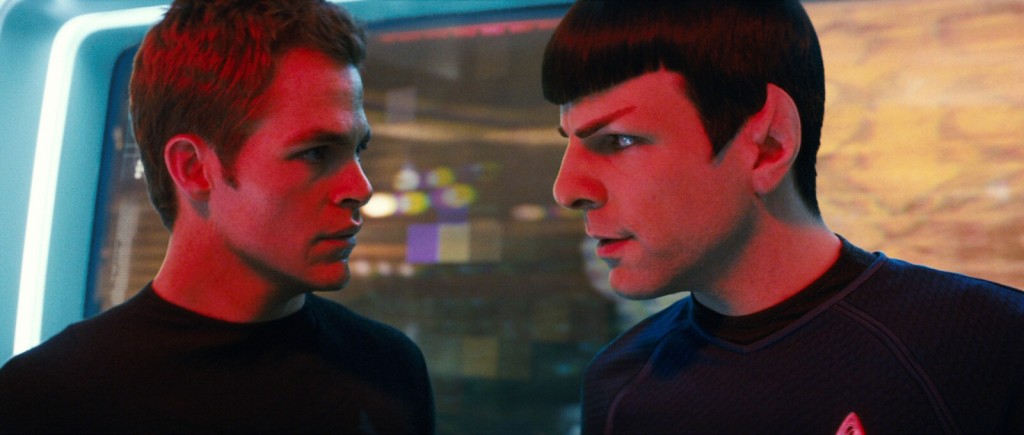
I’m a huge Trekkie.I admit to loving all ten movies (yes, even Nemesis) and all 5 of the TV shows (including all four seasons of the short-lived and disappointing Enterprise).When it comes to anything Trek I have a hard time being objective.So it was a foregone conclusion that I would love J. J. Abram’s new Star Trek.But as painful as it is to say this, I’ve managed to muster the strength to be objective, and I have to give the movie a solid B (maybe a B+).
It was definitely entertaining.Not only was it packed with non-stop action, interspersed with scenes of touching drama and great comic relief, but the characters were perfect.The actors managed to give us just enough of the original that we were instantly familiar with them, and yet breath some of their own style into the role.And while the plot seems a bit cumbersome (not unlike the seventh film in the franchise, Generations), I can write off most of that as an effect of the need for the writers to alter the established Trek timeline in order to make their own version of the original series.All that I am left with in terms of criticism are some minor complaints (which I won’t take the time to mention here, but suffice it to say that they all revolve around the insane number of barely believable plot devices that were required to move Kirk from a fresh-faced cadet to Captain of Starfleet’s flagship in the course of about one day), and then one BIG complaint, which centers around the relationship between Kirk and Spock.
It has been suggested (and I can’t remember by whom) that the Kirk-Spock-McCoy trio is a good representation of Plato’s tripartite soul:Spock representing the logical nous, Kirk representing the brave and powerful “chest”, and McCoy the emotional, appetitive part of the soul.Spock and McCoy are the extremes, kind of like the little angels on Kirk’s shoulders, and Kirk is somewhere in the middle, using the advice and perspectives of both of his closest friends to make his decisions.But in this movie, that dynamic is removed in favor of a stark contrast between “faith” and “reason.”In the beginning, Pike praises Kirk for a spirit that leaps without looking, suggesting that such cautionless risk-taking is something that Starfleet has lost.The parallels between this and the Kierkegaardian “blind leap of faith” are made stronger when, at the end of the film, the elder Spock councils his younger self to put aside logic and “do what feels right”, referring to his own actions earlier in the film as “an act of faith.”
One of the problems this creates for the film is that it becomes very hard to feel any sympathy for the character of Spock.Kirk is always hot-headed and seemingly irrational, and yet he is always right.He jumps without looking, cuts corners, cheats on tests, and repeatedly disobeys orders, and the whole time you’re just waiting for him to get rid of Spock and take command of the Enterprise.Meanwhile Spock only gains our sympathy after he realizes he was being a cold jerk and submits to Kirk’s leadership.In short, Kirk never learns anything; He never grows.This creates a skewed picture.Instead of showing faith (or emotion) and reason to be complementary and essential to one another, they become opposed.The middle element of the soul is removed and it becomes simply a battle between cold logic and raging emotions.This certainly wasn’t the intention of the writers, since we are meant to think that it is the coming together of the unstoppable duo of Kirk and Spock that wins the day in the end.But one need only ask the question, in what way does Spock contribute to this duo?Certainly not as a counter-balancing force to Kirk.Instead, we have a repentant Spock who follows entirely Kirk’s lead.Even near the end of the final battle, when Spock is expressing doubts about his ability to pilot his future self’s ship and successfully complete their mission (a rather logical concern), Kirk merely silences him by repeating “It’ll work”, and that’s that.At every turn it seems as though logic and reason are more of a hindrance than a help.Spock has little to offer the heroic, rebellious young Kirk, except to shut up and go along with his instincts.What we are left with, I think, is an unbalanced, uber-macho Krik who always gets his way by doing what he wants and feeling his way around in the world with nothing but blind faith.And standing right beside him is a Spock to whom he can always turn and say, “I told you so.”
I am, however, still optimistic that much of this will see some resolution in the sequel.In this first movie we see the strength of passion and risk-taking.And in some ways this was all necessary to propel Kirk into the Captain’s chair.But now that he’s sitting there, the writers have a marvelous opportunity to humble him.What I would like to see in the next film is Kirk’s brash risk-taking get him into some deep trouble; trouble that he can only get out of after learning a hard lesson, and only with the help of Spock and his logic.Abrams said from the start that he was always fascinated by the interplay between Kirk and Spock, emotion and reason, faith and science (and he even attempted to mirror this relationship in LOST with the two main characters, Jack and Locke).But what could have been a fascinating look into the relationship of these two seemingly opposed aspects of the human mind/soul and how vital they are to one another, ended up being a rather simplistic, Disney-esque message of “follow your heart.”I hope the relationship will begin to see deeper and more sophisticated exploration in the next movie (without losing all the “low brow” action and humor, of course!).
If abortion is the killing of an innocent human being as pro-lifers say, is it right to kill an abortion doctor–a guilty human being who has been and will be involved in these killings? I think most pro-lifers intuitively have a strong, negative reaction to this question, even if they can’t articulate precisely why such an action would be wrong, given the moral crime and what’s at stake. Does this question reveal a contradiction in pro-life thinking? No. There is solid, consistent reasoning that explains why this negative reaction is the correct one for pro-lifers. While I do hope that someday the government will recognize the heinousness of abortion and prosecute abortion providers in the same way that it currentlyprosecutes anyone other than an abortion provider who kills an unborn child, it would not be morally right or just for me to carry out this punishment on my own.
There are only two reasons why a person might think himself justified in killing an abortion doctor, and both reasons fail morally:
1. Justice for past killings
2. Prevention of future killings
Justice: In Romans 12-13, Paul explains to us God’s system of justice by addressing our place as individuals and the role of government. First, he says in 12:19:
Never take your own revenge, beloved, but leave room for the wrath of God, for it is written, “Vengeance is Mine, I will repay,” says the Lord.
We learn two things from this. First, God cares about justice. People who do seriously wrong things will be seriously, rightfully punished. God will undeniably see to this in every case. He does not sweep any wrong thing under the rug. Second, this verse makes it clear that, as individuals, we are not allowed to mete out justice to anyone. It’s important to remember, however, that there is nothing wrong with desiring to see justice done. In fact, according to this verse, the very reason we are able to rest and not seek vengeance on our own is because we can trust God to justly punish.
But Paul doesn’t leave us there. He goes on immediately in 13:1-7 to explain the institution God created and endowed with the authority to act in His place on earth to bring about justice–government:
Every person is to be in subjection to the governing authorities…. Do you want to have no fear of authority? Do what is good and you will have praise from the same; for it is a minister of God to you for good. But if you do what is evil, be afraid; for it does not bear the sword for nothing; for it is a minister of God, an avenger who brings wrath on the one who practices evil.
When God repays, He does this through government (empowered to act in His place), in the afterlife, or on the cross. These are the ways justice is rightfully accomplished. Therefore, even if our government fails to prosecute as it should, we still do not have the right to act on our own to punish because we haven’t been given the authority to do so. The rule of law would not survive thousands of vigilantes. All of this is why God has commanded us to let go of vengeance, even if the government fails in a particular case to “bring wrath on the one who practices evil.” If we rebel against this command, we are rebelling against God Himself. Therefore, it is clearly wrong for any individual to kill an abortion doctor for the sake of justice.
Prevention: The argument that killing an abortion doctor will save the lives of the babies he intended to kill also morally fails. It fails for the simple reason that this will not save lives in the long run. In fact, it could very well increase the number of lives lost by setting back progress that has already been made. The abortion doctor is not, himself, the source of abortion; killing him will not end abortion. The appointments he had scheduled will be taken on by other providers. But in the meantime, hatred against the pro-life movement will be stirred up because of the lawlessness of the act, heels will dig in out of defiance, more restrictions will be placed on pro-life groups, and persuasion will be much more difficult. In order to make significant progress in saving lives, we must change the view of the people of this nation and thereby change the laws through the democratic process. That is the way this country works. Since unauthorized violence by individuals is completely counterproductive to the goal of persuasion, killing an abortion doctor is morally wrong because it impedes (if not destroys) the work being done to save lives.
The appropriate solution for justice and prevention is this: We must leave justice for each individual abortion doctor in the hands of God as we work through the means of rational persuasion to change the system so that the government will prosecute such things in the future, preventing countless deaths.
[Please note that this is not meant to be an exhaustive discussion of either the reasons why such an action is wrong or the ways that abortions might be prevented.]
June 1, 2009 Posted by Roger OvertoncloseAuthor: Roger OvertonName: Roger Overton Email: rogeroverton@hotmail.com Site:http://ateamblog.com About: Roger Overton is currently pursuing a Masters degree at Talbot School of Theology. He has addressed various churches, schools and youth camps throughout the United States. Roger was co-editor of The New Media Frontier (Crossway, 2008) and God and Governing (Wipf & Stock, 2009).
Roger can be emailed at rogeroverton@hotmail.com.See Authors Posts (570)
A few months ago Penn Jillette (of Penn & Teller) posted a video about an encounter had with a Christian who gave him a Bible. Penn is a self-described atheist, and in the past has described those who believe in God as dangerous. Given his background, this video is especially interesting…
There were a number of things that struck me about what Penn said. One was the inconsistency of his worldview. As much as I prefer atheists who appreciate that evangelism is a necessary consequent of the Christian worldview, I’m not sure how Penn can believe that what this man did was “good” within the framework of his worldview. Penn said, “This guy was a really good guy. He was polite, and honest, and sane, and he cared enough about me to proselytize and give me a Bible.” He also referred to the guy as “polite person living his life right.” Without God, where does Penn ground his understanding of what is good? Why are politeness, honesty and sanity admirable traits?
That point of inconsistency, though important, is less important than what actually happened. Penn, being a known atheist, has likely heard a number of arguments for God’s existence and the very message of the gospel itself. But what struck him enough to make this video was not an argument or eloquent words. Several times Penn noted that the man looked him in the eyes and was genuinely complimentary and polite. What struck Penn was love.
I take this video to be a reminder that people are more important than arguments- that showing love is more important than being right. Penn is right when he says that if you love someone, you will do what you can to save them. There are many truths we can communicate as Christians and various ways we can communicate them, but most often what really communicates God’s grace is living out the virtues exemplified by Christ.
I know I’m sliding this in just before Roger’s Monday post, but I found this chart posted by Jason Robertson to be a great resource for a quick comparison between Dispensationalism and Covenantalism, and thought I’d share it here. Enjoy!
First, a specification: this post is intended for Christians, specifically those Christians who are struggling with the issue of faith and reason.Not that it wouldn’t be instructive (hopefully) for our non-Christian readers, but I will be speaking in a way that presupposes a Christian commitment to the God of the Bible and to the Scripture as authoritative. I am merely giving humble advice for the growing Christian, and not offering (here) an apologetic for the position I am presupposing.
Some Christians struggle at certain times with what they perceive to be discrepancies between what they think they are being asked to take on faith and what their reason tells them.One friend once put it to me this way: At what point do we disengage our minds for faith? At what point is it reasonable? At the point where it forces us to deny Scripture? That must be the dividing line, right?
I really think that Augustine had it right – “faith seeking understanding.” To live by faith is not to disengage your mind. We trust (pisteo) God, both His God-ness and his word, and this gives us sufficient ground to stand on from which we can seek understanding. So take what you find in His Word on faith/trust (it’s not a blind faith, He is trustworthy), but don’t stop there! Work to understand, to see how the pieces fit together. In this way we can glorify God by pursuing knowledge of Him.
When I’m seeking to understand what I believe on trust, here are some helpful operating premises that I use:
1. The truth will be consistent. The more consistent my views are with one another, while in no way guaranteeing their truth, the more confident I am that I’m on the right track.
2. Just because something doesn’t make sense to me now doesn’t mean it won’t after some hard work. A lot of people have been thinking about these things a lot longer than I have, and I have a lot to learn from those who came before.
3. Reason was given to us for our discernment, among other things, and is the faculty by which we apprehend God’s truth. So reason is crucial for us to determine what is true and what is false.
4. When my reason seems at conflict with Scripture, there are two options for me as a faithful Christian: my reason is correct and my understanding of Scripture is incorrect, or my understanding of Scripture is correct and my reason is incorrect. I always try to start by letting the Scripture say what it says, and then list all possible interpretations that don’t do violence to the text. Some really can only mean one thing; at other places, there might be two or three valid understandings. If my confidence in what I think the text is saying outweighs my confidence in what I reason philosophically to be true, then I adjust the latter in light of the former. If, on the other hand, there is a valid reading of the text (that isn’t just me trying to find a loop-hole) that comports with what my reason tells me, then I tend to go with that.
5. There are certain areas that I expect to be unable to fully understand so that all my questions are answered (the Trinity being one example). However, I think too many people put too much of what Scripture labors to teach (so that we might know!) into this category (election being one example, in my view). I only want to put those things there that in principle belong, and I want to understand as much as I can before I give up.
I’m a truth hound – there’s little I like more than hunting down the truth. This gives me the drive, I think, to keep looking for ways to make sense of what the Bible teaches when others might give up and just say, “You just need to have faith.” I do have faith – I’m convinced God’s Word is true – but I want to know how it all makes sense and works together, and this is a crucial part of the adventure of my Christian walk.
How often we approach the throne of grace as desperate beggars. Yet He never once turns us away, but lavishes the richest of riches upon us. 2009-10-06
 June 22, 2009 Posted by David N
 Posted in David's Posts, Theology
  No Comments »


 iminate some of this by structure – for instance, though we have a DVD player in our van, we use a system to regulate its use that utilizes beans. The boys each earn beans for good behavior, and when one of them reaches ten beans he may choose a movie, thus providing motivation to behave well, spacing out movie-watching so we’re not doing that all the time, and avoiding squabbles over whose turn it is to pick a movie and what that movie will be.
 I’m a huge Trekkie.

 content rss
Recent Comments