 December 21, 2009 Posted by Roger Overton
 closeAuthor: Roger Overton
Name: Roger Overton
closeAuthor: Roger Overton
Name: Roger Overton
Email: rogeroverton@hotmail.com
Site: http://ateamblog.com
About: Roger Overton is currently pursuing a Masters degree at Talbot School of Theology. He has addressed various churches, schools and youth camps throughout the United States. Roger was co-editor of The New Media Frontier (Crossway, 2008) and God and Governing (Wipf & Stock, 2009).
Roger can be emailed at rogeroverton@hotmail.com.See Authors Posts (570)
This is the ninth part in a twelve part devotional commentary on “O Holy Night.” See the introduction here.
Truly He taught us To love one another;
His law is love And His gospel is peace.
God the Father did not send the Son simply to die for our sins and then abandon us to continue to live in disobedience to Him. Nor does He now expect us to live perfectly, though we have a perfect example in His Son. We are called to work out our salvation with fear and trembling by the power of the Holy Spirit in such a way as to radiate the grace of His love throughout our lives.
I think the next four segments of O Holy Night give us four responses to the Evangel. Here we see the first; what Jesus referred to as the greatest commandment: “You shall love the Lord your God with all your heart and with all your soul and with all your mind. This is the great and first commandment. And a second is like it: You shall love your neighbor as yourself. On these two commandments depend all the Law and the Prophets.”
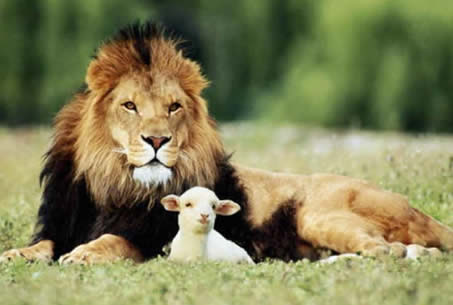
Jesus demonstrated His love for us by laying His life down for us, and we are called to do likewise for others. “Therefore be imitators of God, as beloved children. And walk in love, as Christ loved us and gave himself up for us, a fragrant offering and sacrifice to God.” (Eph 5:1-2) The law He has given us for the new covenant is love- love that reflects the peace the gospel brings between God and man.
This commandment was given another way in the Gospel According to John: “A new commandment I give to you, that you love one another: just as I have loved you, you also are to love one another. By this all people will know that you are my disciples, if you have love for one another.” (John 13:34-35) Jesus issued a standard by which all people can judge whether or not we follow Jesus; whether or not we are truly Christians. If we do not show love for one another, the world has a right to judge that we are not believers.
Jesus took this a step further in His high priestly prayer in John 17:20-21. He prayed that his disciples “may all be one, just as you Father, are in me, and I in you, that they also may be in us, so that the world may believe that you have sent me.” Francis Schaeffer referred to this unity demonstrated through love as the “final apologetic.” How we live to some degree determines what believe about Jesus. If we truly live in the unity God has exemplified for us, the gospel will be advanced throughout the world. Indeed He has taught us to love one another, and more than that, He has given us the means and motivation to do so.
 Posted in Poetry/Scripture/Liturgy/Etc., Roger's Posts
  1 Comment »
December 18, 2009 Posted by Roger OvertoncloseAuthor: Roger Overton
Name: Roger Overton
Email: rogeroverton@hotmail.com
Site: http://ateamblog.com
About: Roger Overton is currently pursuing a Masters degree at Talbot School of Theology. He has addressed various churches, schools and youth camps throughout the United States. Roger was co-editor of The New Media Frontier (Crossway, 2008) and God and Governing (Wipf & Stock, 2009).
Roger can be emailed at rogeroverton@hotmail.com.See Authors Posts (570)
This is the eighth part in a twelve part devotional commentary on “O Holy Night.” See the introduction here.
He knows our need, To our weakness is no stranger,
Behold your King! Before Him lowly bend!
Behold your King, Behold your King.
Being God, Jesus obviously knows what we need. His omniscience is not limited by our self-perceived liberty or isolation. He sees all and knows all things simply by virtue of his deity.
What’s in view here, however, is not really the divine attribute of omniscience, but the experiential knowledge gained by Jesus as he lived, died and was resurrected. We are told that Jesus “increased in wisdom and in stature” (Luke 2:52). Jesus was tempted three times by Satan before He began His ministry, and we are later told the He is “one who in every respect has been tempted as we are, yet without sin.” (Hebrews 4:15)
There’s a comfort that comes with the understanding that He’s experienced our needs and weaknesses. I think it adds some tenderness to many of the things we read, such as when Jesus told Paul, “My grace is sufficient for you, for my power is made perfect in weakness.” (2 Cor 12:9) He could say that knowing from experience the pain Paul went through.
Jesus experienced these things, “yet without sin.” He claimed victory over temptation, sin, and death. And so He was “declared to be the Son of God in power according to the Spirit of holiness by his resurrection from the dead.” (Romans 1:4) “Therefore God has highly exalted him and bestowed on him the name that is above every name, so that at the name of Jesus every knee should bow, in heaven and on earth and under the earth, and every tongue confess that Jesus Christ is Lord, to the glory of God the Father.” (Phil 2:9-11)
Because He is victorious, we know He is King of all things. We are called to lowly bend before Him; to come adore and behold Him.

Posted in Poetry/Scripture/Liturgy/Etc., Roger's Posts 1 Comment »
December 17, 2009 Posted by Roger OvertoncloseAuthor: Roger Overton
Name: Roger Overton
Email: rogeroverton@hotmail.com
Site: http://ateamblog.com
About: Roger Overton is currently pursuing a Masters degree at Talbot School of Theology. He has addressed various churches, schools and youth camps throughout the United States. Roger was co-editor of The New Media Frontier (Crossway, 2008) and God and Governing (Wipf & Stock, 2009).
Roger can be emailed at rogeroverton@hotmail.com.See Authors Posts (570)
This is the seventh part in a twelve part devotional commentary on “O Holy Night.” See the introduction here.
The King of Kings Lay thus in lowly manger;
In all our trials Born to be our friend.
The King of Kings is a lofty title. I used to think of it merely as God ruling over all the rulers on Earth. That, of course, is true. But it also encompasses the full scope of God’s reign. Everything we think a King might control or ought to be, God controls and is. God is the epitome of Kingship. He reigns sovereignly over all things large and small because it is His, and He manages His creation with perfect wisdom and justice. There are no boundaries to His kingdom. Unlike our American President, there are not checks and balances on God. He is free to act and will according to His desires.
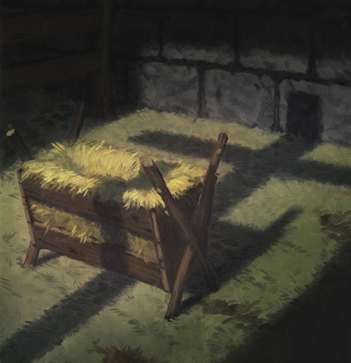 Yet we find this most magnificent King in a most lowly place, a manger. We are again pointed back to the mystery of the incarnation, to Philippians 2 “He made himself nothing, taking the form of a servant, being born in the likeness of men.” Though man is dust, God became man in order to save man.
Why would a utterly holy God stoop to such a lowly place? What could motivate Him to make Himself “nothing”? We are told in one of my favorite lines, “In all our trials born to be our friend.” The love of God is such a deeply rich love that it compelled Him to become “nothing” in order to be our dearest friend (amongst other titles, of course).
This friendship is costly. Not only did God have to become man, but He also had to die, as we saw in the last post. Jesus told us that true love is laying down one’s life for another. The only way God could truly love is by accomplishing this act. And because of the horrible mark of sin on our lives, the only way He could be our friend is through covering us with the perfectly righteous blood of His Son.
“Born to be our friend” assumes much because of cost required for God to be our friend. It is an expression of the gospel, that God so loved us that He did indeed send His Son to reconcile us to Him. In Him we find our truest companion, our dearest friend.
Posted in Poetry/Scripture/Liturgy/Etc., Roger's Posts 1 Comment »
December 14, 2009 Posted by Roger OvertoncloseAuthor: Roger Overton
Name: Roger Overton
Email: rogeroverton@hotmail.com
Site: http://ateamblog.com
About: Roger Overton is currently pursuing a Masters degree at Talbot School of Theology. He has addressed various churches, schools and youth camps throughout the United States. Roger was co-editor of The New Media Frontier (Crossway, 2008) and God and Governing (Wipf & Stock, 2009).
Roger can be emailed at rogeroverton@hotmail.com.See Authors Posts (570)
This is the sixth part in a twelve part devotional commentary on “O Holy Night.” See the introduction here.
So led by light of A star sweetly gleaming,
Here come the wise men From Orient land.
 These two lines again point to the star over Bethlehem. But there is a subtle difference to its appearance in these lines. Before it was a “light of faith,” here it is simply “light of a star.”
At first glance, these lines are coldly historical: There’s light from a star and it guides wise men from a distant land. If we are to draw something out of this, I think it is the historical nature of the story. We are surrounded by stories and mythologies. At this time of year Santa Clause is an especially popular mythology. And while there are historical roots that Santa Clause grew out of, it’s not really a true myth.
The story of Jesus’ birth is true myth, and it must be so. Paul wrote to the Corinthians: “For if the dead are not raised, not even Christ has been raised. And if Christ has not been raised, your faith is futile and you are still in your sins. Then those who have fallen asleep in Christ have perished. If in this life only we have hoped in Christ, we are of all people most to be pitied.” (1 Cor 15:16-19)
Here Paul claimed that the gospel and all of Christianity depends on the historical veracity of one truth- the death and resurrection of Jesus. If it didn’t happen, our beliefs are as meaningful as the tooth fairy, and we have devoted our lives to a lie. But if it did happen, if Jesus truly died and was truly raised, then we owe Him everything and He will change our lives.
In Romans, Paul says that Jesus “was declared to be the Son of God in power according to the Spirit of holiness by his resurrection from the dead.” (1:4) Indeed, Christ has died and been resurrected, and it is by His resurrection that we now Him to be Lord over all things. His physical introduction into our history was of such magnitude that it even drew the attention of “wise men” from a distant land. We believe not just in the theological significance of the incarnation, but also in it’s historical nature.
Posted in Poetry/Scripture/Liturgy/Etc., Roger's Posts 1 Comment »
December 11, 2009 Posted by Roger OvertoncloseAuthor: Roger Overton
Name: Roger Overton
Email: rogeroverton@hotmail.com
Site: http://ateamblog.com
About: Roger Overton is currently pursuing a Masters degree at Talbot School of Theology. He has addressed various churches, schools and youth camps throughout the United States. Roger was co-editor of The New Media Frontier (Crossway, 2008) and God and Governing (Wipf & Stock, 2009).
Roger can be emailed at rogeroverton@hotmail.com.See Authors Posts (570)
This is the fifth part in a twelve part devotional commentary on “O Holy Night.” See the introduction here.
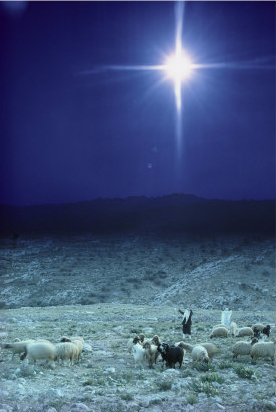 Led by the light of Faith serenely beaming,
With glowing hearts By His cradle we stand.
The “light of faith serenely beaming” likely refers to the star over Bethlehem that led the magi to Jesus. In Matthews account we are told that “when they saw the star, they rejoiced exceedingly with great joy.” (2:10) Just the journey to Jesus was cause for joy, and it culminated in standing by His cradle with glowing hearts. More than simply rejoicing, at the sight of Jesus the wise men “fell down and worshiped him.” (2:11)
We understand these things “by the light of faith.” Hebrews 11 tells us that “faith is the assurance of things hoped for, the conviction of things not seen.” Faith helps us see with something other than our eyes. We are told that “by faith we understand that the universe was created by the word of God.” (11:3)
What follows in Hebrews is a list of people who did things “by faith” that would not have done without it. They acted on their ability to see reality in a light different from fallen man. “These all died in faith, not having received the things promised, but having seen them and greeted them from afar, and having acknowledged that they were strangers and exiles on the earth.” (11:13)
We are further told to “run with endurance the race that is set before us, looking to Jesus, the founder and perfecter of our faith.” (12:1-2) Jesus is fundamental to the light that faith provides us. Without His blood cleansing us of our sinful guilt, we would still be living in darkness. But since He has redeemed us and since He is the light of God, we now have eyes that can see and ears that can hear.
For this reason, we too should come with glowing hearts beside His cradle. “Draw near with a true heart in full assurance of faith,” and come, let us adore Him.
Posted in Poetry/Scripture/Liturgy/Etc., Roger's Posts No Comments »
December 9, 2009 Posted by Roger OvertoncloseAuthor: Roger Overton
Name: Roger Overton
Email: rogeroverton@hotmail.com
Site: http://ateamblog.com
About: Roger Overton is currently pursuing a Masters degree at Talbot School of Theology. He has addressed various churches, schools and youth camps throughout the United States. Roger was co-editor of The New Media Frontier (Crossway, 2008) and God and Governing (Wipf & Stock, 2009).
Roger can be emailed at rogeroverton@hotmail.com.See Authors Posts (570)
This is the fourth part in a twelve part devotional commentary on “O Holy Night.” See the introduction here.
Fall on your knees! O, hear the angels’ voices!
O night divine, O night when Christ was born;
O night divine, O night, O night Divine
There are two pictures of heavenly worship in the Bible that have always made a deep impression on me. In Isaiah 6 the seraphim around God’s throne call out “”Holy, holy, holy is the Lord of hosts; the whole earth is full of his glory!” In Revelation 4 the “living creatures” never cease to say “”Holy, holy, holy, is the Lord God Almighty, who was and is and is to come!” They are followed by twenty four elders who say “Worthy are you, our Lord and God, to receive glory and honor and power, for you created all things, and by your will they existed and were created.”
At the beginning of Revelation (1:17) John worships the correct person, Jesus the Messiah (he later bows down before angels and is sternly corrected in 19:10 and 22:8). And this should also be our response to the coming of our Lord and savior into the world. He who came as a lamb to the slaughter was none other that the Lord of all creation, the very Word of God. “And the Word became flesh and dwelt among us, and we have seen his glory, glory as of the only Son from the Father, full of grace and truth.” (John 1:14)

We sing “O night divine” because our transcendent God is also immanent. Our God does not look at us from afar, wondering about us or worrying about our sinful state. He stepped into our world to bring peace and adopt us as His very own. The divine broke into the earthly realm, but the lower state did not diminish His divinity.
“Jesus, who, though he was in the form of God, did not count equality with God a thing to be grasped, but made himself nothing, taking the form of a servant, being born in the likeness of men. And being found in human form, he humbled himself by becoming obedient to the point of death, even death on a cross. Therefore God has highly exalted him and bestowed on him the name that is above every name, so that at the name of Jesus every knee should bow, in heaven and on earth and under the earth, and every tongue confess that Jesus Christ is Lord, to the glory of God the Father.” (Phil 2:5-11)
Indeed, a day is coming when every knee will bow as it should, if it has not already. Until that day, we add our voices to the heavenly choir in praise to Him who was born on that night divine.
Posted in Poetry/Scripture/Liturgy/Etc., Roger's Posts 1 Comment »
December 7, 2009 Posted by David N closeAuthor: David N
Name:
closeAuthor: David N
Name:
Email: dvnilsen@gmail.com
Site: http://reasonfromscripture.blogspot.com
About: In 2003 I graduated from high school with no set direction for my life. I spent a year in Iowa before returning to California to attend Junior College. I changed majors 3 times; from Physics to Business to Film (as you can see, no direction). I was a Christian, attending church regularly, but furthering the cause of Christ in this fallen world was not a high priority.
In 2005 I picked up an issue of TableTalk magazine, and I was re-introduced to the work of R. C. Sproul (whom I had read once in high school). Later that year, while taking a biology class with an ardent atheist professor, I picked up a copy of Lee Strobel's "The Case For A Creator." In the Fall of 2006 I came to Biola University and was introduced to the works of J. P. Moreland and John Mark Reynolds. My fate was sealed.
Just a few years ago, I was passionless. Now I have two passions: Studying the Word of God and engaging in the task of Apologetics. 1 Peter 3:15 exhorts all Christians to be ready to give an answer for the hope that we have. My goal is to be able to give my answer articulately and powerfully, but even more importantly, in love. There are many purposes for apologetics, but by far the most important is the opening of minds and the softening of hearts for the work of the Holy Spirit. If we don't care about and pray for those with whom we engage in apologetics, we fail to fulfill this purpose. As a wise man once said, "Take a stand for the Truth, but do it in love fool!"
Education Info:
--Currently: M.A. in Historical Theology student, Westminster Seminary California
--2008: B.A. in Philosophy, Biola University
--2006: A.A. in Liberal Arts, Palomar CollegeSee Authors Posts (75)
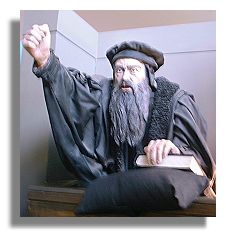 Dr. John Mark Reynolds has written this rather interesting blog post over at Scriptorium Daily in which he gives ten reasons that “dour” Calvinists ought to cheep up this Christmas.
As a Calvinist who is neither dour nor “cool” nor anything like Katie Couric (just read the blog post and you’ll understand what I’m talking about), I still found this post quite amusing (if only because it shows all the signs that Dr. Reynolds was very tired with a little too much residual caffine in his system while writing it) and I am definitely cheered up! The only thing that I still cannot understand is Dr. Reynold’s obsession with John Knox. It’s really reached an unhealthy level, I think. 😛
(I just realized that this statue of Knox looks a lot like a grumpy Gandalf and/or Dumbledore. I guess the Eastern Orthodox don’t have the market cornered on wizards after all!)
Posted in David's Posts 1 Comment »
December 7, 2009 Posted by Roger OvertoncloseAuthor: Roger Overton
Name: Roger Overton
Email: rogeroverton@hotmail.com
Site: http://ateamblog.com
About: Roger Overton is currently pursuing a Masters degree at Talbot School of Theology. He has addressed various churches, schools and youth camps throughout the United States. Roger was co-editor of The New Media Frontier (Crossway, 2008) and God and Governing (Wipf & Stock, 2009).
Roger can be emailed at rogeroverton@hotmail.com.See Authors Posts (570)
This is the third part in a twelve part devotional commentary on “O Holy Night.” See the introduction here.
A thrill of hope The weary world rejoices,
For yonder breaks A new and glorious morn.
As a consequence of sin, God cursed the ground (Gen 3:17). Man has had to toil in pain to provide for himself. There is conflict between man and woman and brother fights against brother. The darkness that envelops the world through sin runs through every human heart and stains the very earth upon which we live.
But around 2000 years ago the long dark night of waiting was over at last. Prophecies were meeting their fulfillment. “For we know that the whole creation has been groaning together in the pains of childbirth until now.”(Romans 8:22) A world weary from the burden of sin would soon find rest, reconciliation and redemption. The coming of the Messiah represents a new day that comes after the longest of dark nights.
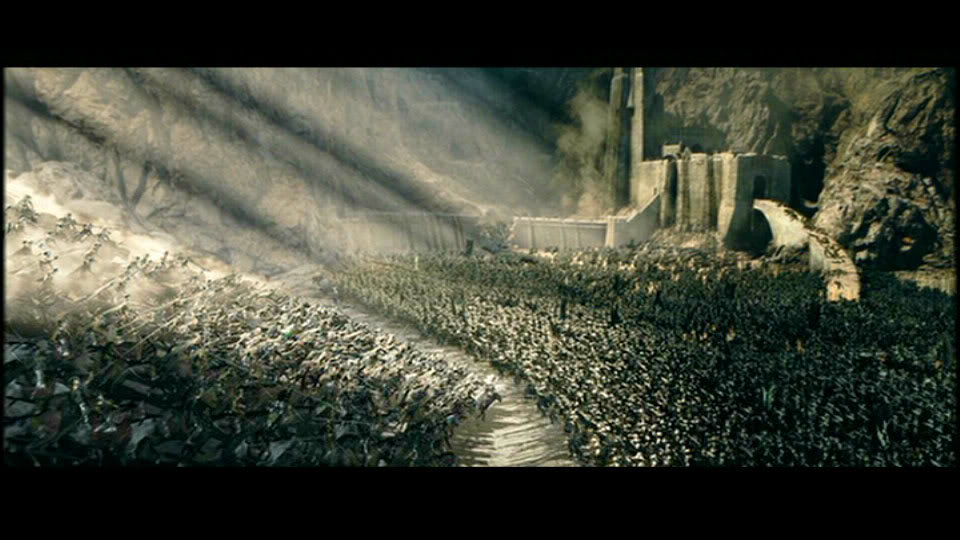
I can’t help but remember an analogous plot in J.R.R. Tolkien’s The Two Towers. With an inevitable battle ahead, the wizard Gandalf must ride away in hope of finding aid from a group of horsemen. He tells Aragorn, “Look to my coming, at first light, on the fifth day. At dawn, look to the East.” The battle comes and it is fierce. An evil race of Orcs (Uruk-hai) was bred for the sole purpose of exterminated men, and they seemed to have the upper hand. Loses and set backs left the men of Rohan with little to no hope as the dark battle raged on. When all seemed lost suddenly a bright light came over the hillside from the East. The light from the horizon pierced the darkness and overcame it. It was Gandalf and the horsemen descending upon the Uruk-hai; forcing them to flee into an enchanted forest that completed the victory.
Yonder breaks a new and glorious morn, but it is no wizard with horsemen to defeat an earthly enemy. It is Jesus our Messiah, descended from the heavens in the form of a servant. Though a league of angels descended with Him, He alone is our victory. He fights not a battle against sword and axe, but against sin and temptation. When all seemed lost, He triumphed over our enemy such that death no longer stings. Glorious indeed is our Messiah’s birth as for us it means a new day is coming- the first of days without end where darkness no longer reigns.
Posted in Poetry/Scripture/Liturgy/Etc., Roger's Posts 1 Comment »
December 4, 2009 Posted by Roger OvertoncloseAuthor: Roger Overton
Name: Roger Overton
Email: rogeroverton@hotmail.com
Site: http://ateamblog.com
About: Roger Overton is currently pursuing a Masters degree at Talbot School of Theology. He has addressed various churches, schools and youth camps throughout the United States. Roger was co-editor of The New Media Frontier (Crossway, 2008) and God and Governing (Wipf & Stock, 2009).
Roger can be emailed at rogeroverton@hotmail.com.See Authors Posts (570)
This is the second part in a twelve part devotional commentary on “O Holy Night.” See the introduction here.
Long lay the world In sin and error pining,
‘Til He appear’d And the soul felt its worth.
The dark world into which our Savior was born is one living in sin. Paul, quoting Psalms, tells us:
None is righteous, no not one;
no one understands;
no one seeks for God.
All have turned aside; together they have become worthless;
no one does good,
not even one.”
“Their throat is an open grave;
they use their tongues to deceive.”
“The venom of asps is under their lips.”
“Their mouth is full of curses and bitterness.”
“Their feet are swift to shed blood;
in their paths are ruin and misery,
and the way of peace they have not known.”
“There is no fear of God before their eyes.” (Romans 3:10-18)
“No one seeks for God… no one does good.” This is captured well in “long lay the world in sin and error pining.” Instead of seeking God and doing good, the world (in error) pines after lesser things, idols crafted by human hands- their god is their belly.
Pining is one of those older words we don’t hear very often. It does refer to a desperate longing, but it also has a more archaic meaning of discontent and fret. Both reflect what the Bible tells us about the state of the world. In rebellion against God it seeks satisfaction in things that do not satisfy. It is a restless world that will not embrace the one cure that can save it.
 Thankfully there is a message of hope attached to this dire assessment of the world. That hope is found in the appearance of our Savior. His light is the cure for our darkness. All the gods of this world will not satisfy or give meaning to lives that seem like dust in the wind.
Jesus the Christ satisfies thirsty souls that rest in Him and pine for Him. He makes our souls feel their worth because “He is the image of the invisible God” in who’s very image we were made. Only our Creator can give us purpose and fulfill us, and we can find much joy and comfort in the fact that He has come and accomplished this.
Posted in Poetry/Scripture/Liturgy/Etc., Roger's Posts No Comments »
December 2, 2009 Posted by Roger OvertoncloseAuthor: Roger Overton
Name: Roger Overton
Email: rogeroverton@hotmail.com
Site: http://ateamblog.com
About: Roger Overton is currently pursuing a Masters degree at Talbot School of Theology. He has addressed various churches, schools and youth camps throughout the United States. Roger was co-editor of The New Media Frontier (Crossway, 2008) and God and Governing (Wipf & Stock, 2009).
Roger can be emailed at rogeroverton@hotmail.com.See Authors Posts (570)
This is the first part in a twelve part devotional commentary on “O Holy Night.” See the introduction here.
O holy night! The stars are brightly shining,
It is the night of Our dear Saviour’s birth.
The first two lines of the song provide a context for what’s to follow. It’s important that we know our Savior came in the night as the night relates to the darkness of the world. Darkness is, of course, a common metaphor for the evil of the world. Jesus is often referred to as the light.
Emphasis on Jesus as light contrasted to the darkness occurs right at the beginning of the gospel according to John:
1:4-5 “In him was life, and the life was the light of men. The light shines in the darkness, and the darkness has not overcome it.”
1:9 “The true light, which enlightens everyone, was coming into the world.”
Similarly, in 1 John we are told that God is light:
1:5 “This is the message we have heard from him and proclaim to you, that God is light, and in him is no darkness at all.”
1:7 “But if we walk in the light, as he is in the light, we have fellowship with one another, and the blood of Jesus his Son cleanses us from all sin.”
And in Revelation, though the word “light” isn’t present, we find the same idea:
Rev. 1:12-16: “Then I turned to see the voice that was speaking to me, and on turning I saw seven golden lampstands, and in the midst of the lampstands one like a son of man, clothed with a long rode and a golden sash around his chest. The hairs of his head were white like wool, as white as the snow. His eyes were like a flame of fire, his feet were like burnished bronze, refined in the furnace, and his voice was like the roar of many waters. In his right hand he held seven stars, from his mouth came a sharp two-edged sword, and his face was like the sun shining in full strength.”
Whether “the stars are brightly shining” refers to angels or the actual celestial bodies, it appears to be a proclamation of celebration. There is much joy to be had in the coming of light into our dark world.
Indeed, only the light of Jesus can save us in this blinding darkness of night. Left to ourselves, we have eyes but cannot see. Only the light of Jesus can make us see the world as it really is. And this light has come.
But we cannot leave it at that. Jesus says in Matthew 5:14-16 “You are the light of the world. A city on a hill cannot be hidden. Nor do people light a lamp and put it under a basket, but on a stand, and it gives light to all in the house. In the same way, let your light shine before others so that they may see your good works and give glory to your Father who is in heaven.”
We are right to celebrate with the very stars the coming of the light into darkness, but we must also recognize our responsibility, now that He has given us sight, to live in the light and He is in the light. We who follow Him are now the light of the world and are called live in such a way as to reflect His light into the world around us.
Posted in Poetry/Scripture/Liturgy/Etc., Roger's Posts No Comments »


 content rss
Recent Comments